
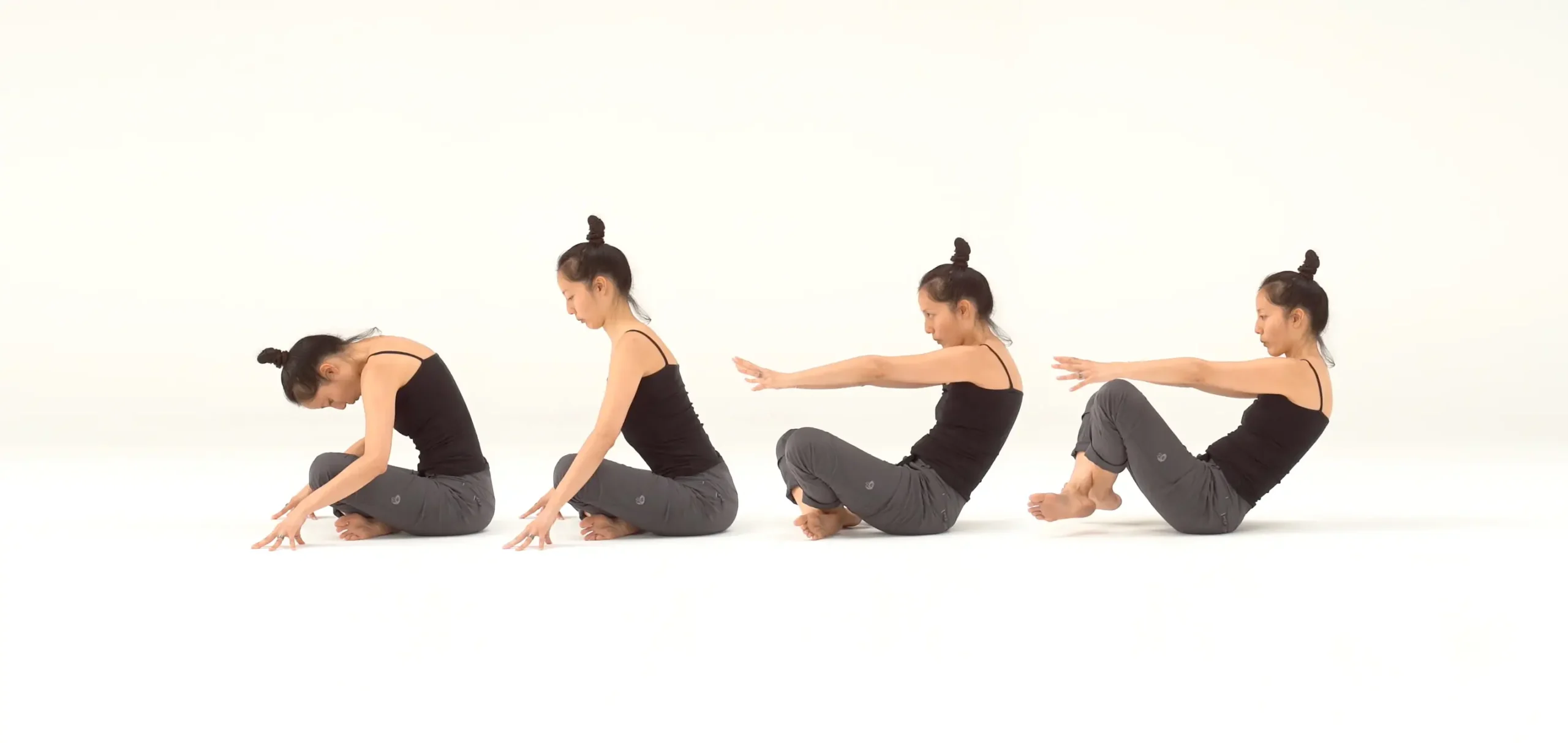
When you watch someone in a movement class—whether it’s a plank, a squat, a dance move, or even simply standing with arms extended—what you’re seeing is only half the story. The visible movements tell you what position the body is in. But they don’t tell you how the person got there, or what’s happening beneath the surface—how they are engaging their muscles and what they experience.
This distinction matters more than most people realize.
The Instruction Gap
Most movement instruction focuses overwhelmingly on visible changes: bend your knees, lift your arm, lower your hips. These are what we call macro-movements—the gross, observable motions that shift your body from one position to another. In a typical session across various disciplines, macro-movement cues dominate the instruction, comprising 97-99% of what you’ll hear.
And these visible movements do important work. They help achieve aesthetic effects in dance, deliver targeted muscle stimulation for strength or flexibility, and create the recognizable forms that define different movement practices.
But here’s what emerged when we analyzed movement instruction across thousands of practice sessions: the practitioners who report the most significant gains in body awareness, control, and the ability to release chronic tension aren’t spending their time primarily on these visible movements. They’re working in a different domain entirely.
The Invisible Difference
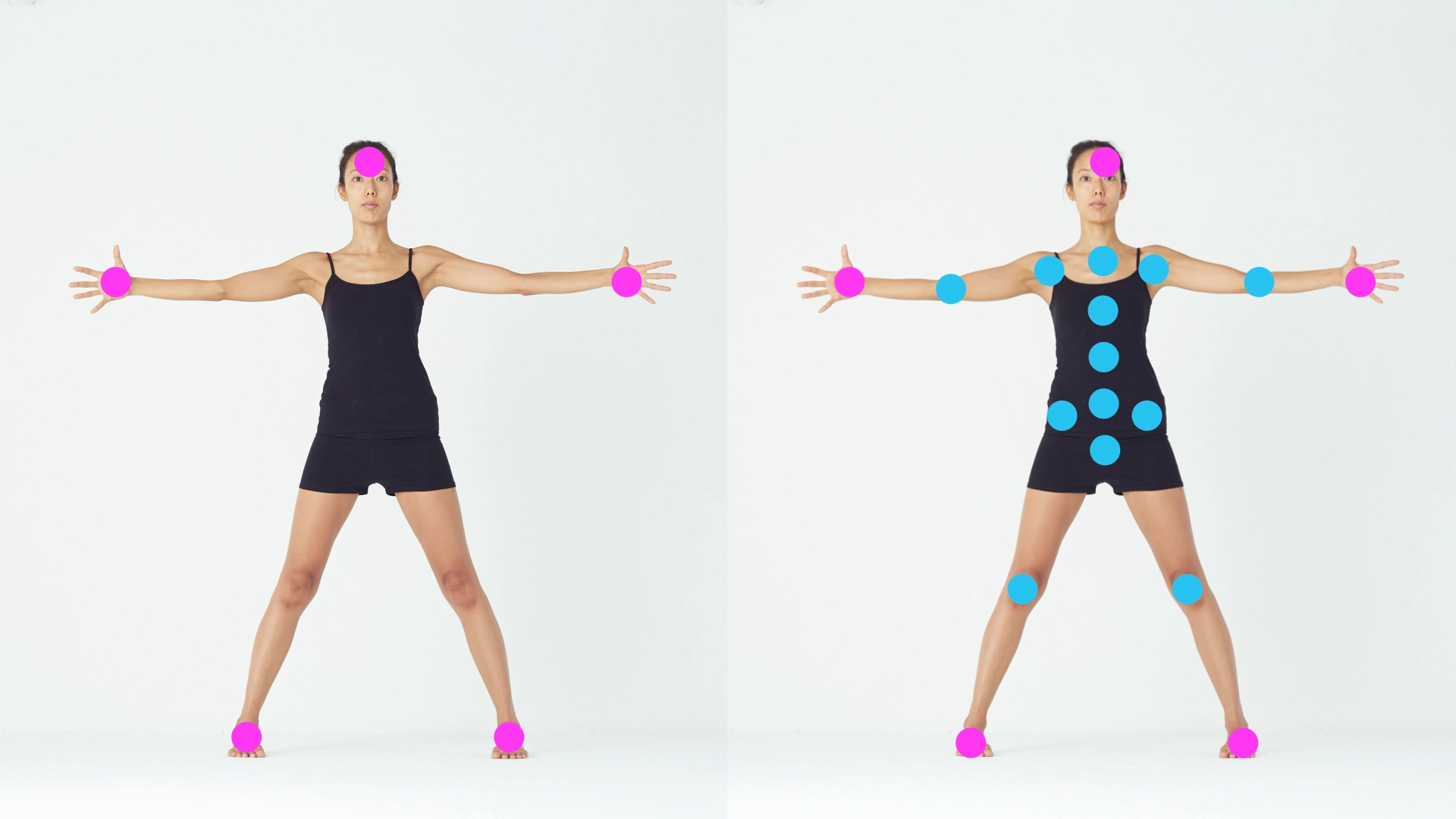
Stand with your arms extended to your sides. Now, without changing what anyone watching you would see, try this: actively spread your fingers, draw your shoulders down, imagine someone pulling your arms away from your torso, keep your wrists and shoulders aligned on an invisible horizontal line, pull your legs away from each other, pull the ribcage in, lightly tuck the pelvis while keeping your spine extended.
You’re now doing eight distinct actions simultaneously, yet to an observer, you appear to be simply standing still.
This is the domain of micro-movements—nearly invisible actions that include isometric contractions, precise positional awareness, and continuous small adjustments. While most movement practices allocate 1-3% of instructional time to this invisible layer, Baseworks dedicates approximately 60% of its instruction here—a proportion similar only to Feldenkrais, which emphasizes micro-movements at about 27% of instruction time, although with a crucial methodological distinction.
Feldenkrais uses micro-movement instruction primarily for relaxation cues—noticing patterns of tension and learning to release them. Baseworks, in contrast, focuses on active low-level contraction and spatial precision. From a neurological perspective, contraction is an action, while relaxation is the absence of action. Therefore, Feldenkrais is about noticing patterns and letting go of tension, while Baseworks is about building actual movement skills through conscious, distributed engagement. Both approaches recognize the importance of the invisible layer, but they cultivate fundamentally different neural processes.
Why Simultaneity Changes Everything
When multiple micro-movements occur at once—as they do throughout a Baseworks session—something neurologically significant happens. Rather than targeting specific muscle groups for specific visible outcomes, you’re creating Distributed Activation across the body: engaging muscles that aren’t traditionally considered “working” in a given position. Just about all muscle groups remain active, even those with no visible role in what you’re doing.
This simultaneity serves multiple functions. Consciously contracting a muscle makes it easier to relax later. Engagement brings blood flow and conscious sensation to areas you may have lost touch with. Holding attention across multiple simultaneous tasks trains stable, distributed awareness. Pre-engaging muscles makes it easier to control the movement. And the constant micro-adjustments—like sketching fine lines that eventually create a clear drawing—develop the neural pathways for genuine motor control rather than just movement repetition.
Patterns, Not Positions
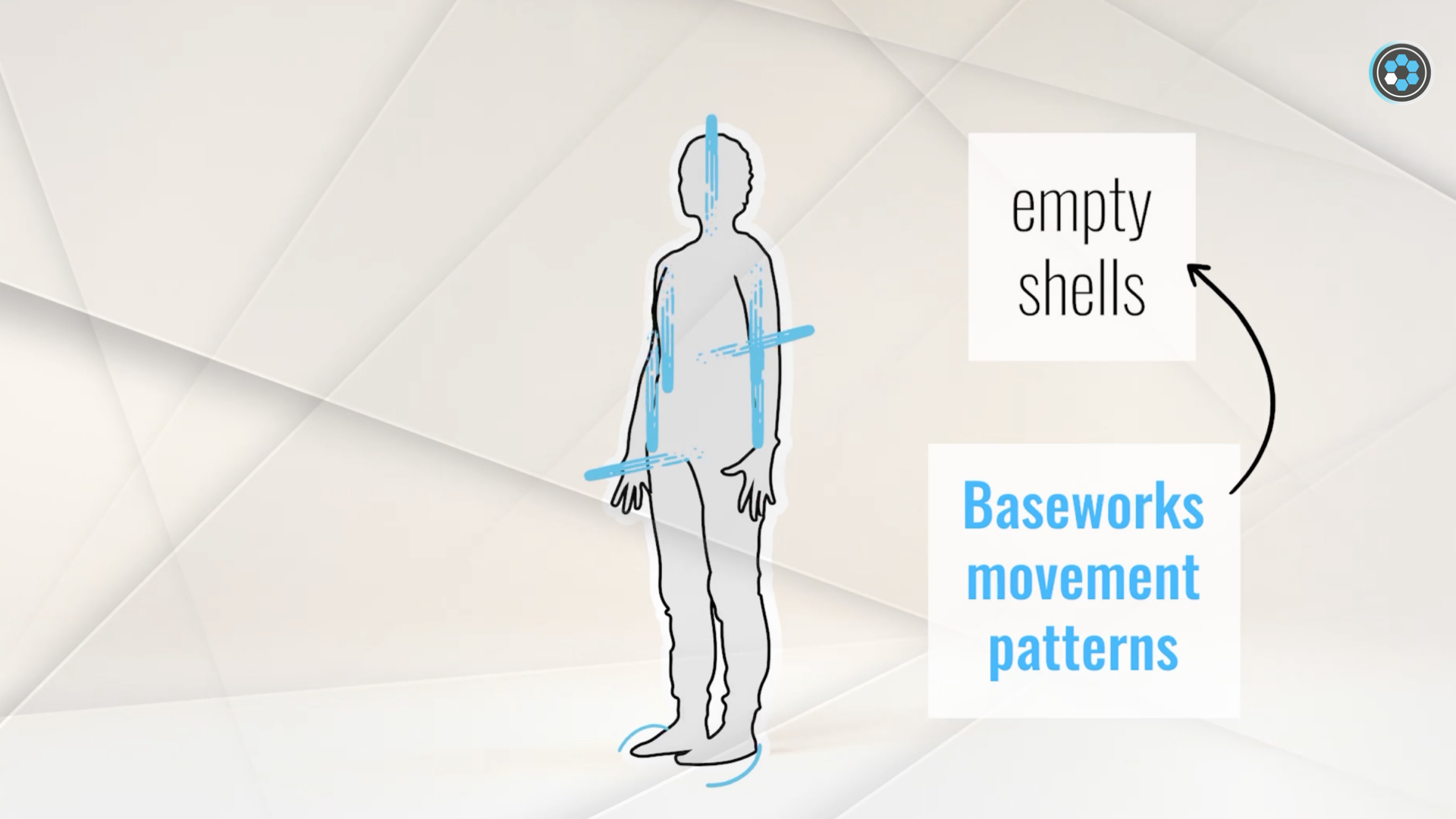
Think of a checkerboard pattern applied to different objects: a shirt, a bag, a cup. The pattern remains consistent even as it adapts to different forms. This is how Baseworks approaches working with the body. The same micro-movement patterns—drawing shoulders down, tractioning limbs, maintaining arm-shoulder alignment—get applied across radically different macro-positions: upright, inverted, lying down, transitioning between positions.
You’re not learning isolated exercises. You’re learning a transferable way of inhabiting your body that applies regardless of what you’re doing.
Who This Matters For
This approach resonates particularly with people who have explored multiple movement modalities but still experience persistent challenges: chronic tension that won’t resolve, difficulty maintaining focus, a sense of being disconnected from parts of the body, or the frustrating experience of “knowing” what you’re supposed to do but being unable to sense whether you’re actually doing it.
These are often knowledge workers—scientists, educators, creatives—who recognize that their physical state affects their cognitive function, but who haven’t found conventional approaches sufficient. They’ve done yoga, Pilates, strength training, or other practices, sometimes for years, and while they may have gained flexibility or strength, something fundamental still feels unresolved.
This approach also resonates with movement professionals—dancers, athletes, physiotherapists—who have highly developed physical skills but want to understand the mechanics beneath their performance. Having the ability to execute a movement doesn’t necessarily mean understanding precisely what the body is doing. Baseworks provides a systematic framework for analyzing movement patterns with high resolution, which can extend careers, prevent injuries, refine technique, and provide new tools for working with others.
The missing piece is often this invisible layer: the conscious, simultaneous engagement that builds genuine sensorimotor integration rather than just movement execution.
The Methodological Distinction
When you analyze instruction across different movement disciplines, distinct signatures emerge. In practices like yoga and Pilates, micro-movement cues comprise just 1-3% of instruction (based on millisecond-resolution textual analysis of representative class videos across disciplines). These approaches focus primarily on visible strength, flexibility, fluidity, and form (and sometimes synchronized breath), with minimal attention to the invisible layer we are talking about.
While Feldenkrais dedicates about 27% of instruction to micro-movements, but 64% of those cues relate to relaxation—sensing and releasing habitual tension patterns. The remaining 36% address spatial positioning.
Baseworks dedicates 60% of instruction to micro-movements, with a notably different composition: approximately one-third relates to how to contract muscles (the isometric engagement of Distributed Activation), and two-thirds to precise spatial positioning (aligning body points with imaginary gridlines, enforcing symmetry).
This combination—high micro-movement emphasis with a focus on active contraction and spatial precision—creates a distinct instructional signature, which also proved to be highly functional.
The method emerged through an iterative refinement process over 10 years with more than 10,000 learners, continuously optimized for “communicability of movement”—helping people who struggled to understand their bodies actually develop concrete skills. This approach—simultaneous muscle engagement with distributed attention—might seem counterintuitive at first, yet work with thousands of students has repeatedly demonstrated that it develops broadly transferable skills, refining performance in other movement practices, even for movements not directly trained in Baseworks.
For the Seekers
If you’ve explored multiple movement approaches but still feel something’s missing—if you’ve gained flexibility but not ease, strength but not control, or if you suspect that the way you inhabit your body affects everything from chronic tension to concentration—you might be someone who would benefit from working in this invisible layer. Among people who attend Baseworks events, they’ve typically explored at least five different movement methods. Yet 66% still experience chronic body tension or pain, and 60% report concentration difficulties. This paradox is revealing: these aren’t sedentary people looking to start moving. They’re already moving extensively, yet these fundamental issues persist.
For movement professionals, the deep dive into the invisible layer offers systematic tools for analyzing what you already do well intuitively, extending the durability and precision of highly developed skills.
The work in Baseworks requires attention, patience, and a willingness to prioritize sensing over performing. It’s difficult at first, precisely because simultaneity challenges our habitual ways of moving. But for those who persist, practitioners report outcomes that include not just perceptual gains but motor skill transfer, stress regulation, and what some describe as shifts in how they fundamentally experience being in a body.
The question isn’t whether you can touch your toes or hold a plank. The question is: how are you doing it?
Baseworks offers introductory sessions and open days for those curious to experience the distinction between macro and micro-movements firsthand: check our Upcoming Events. A practical introduction is also available in our Primer course.

 Apple Podcasts
 Spotify
 Overcast
 Castro
 Amazon Music
 Anchor
 CastBox
 Radio Public
 Breaker
 YouTube
 RSS
RSS Goodpods
 iHeartRadio