
Results for: "Motor Control"
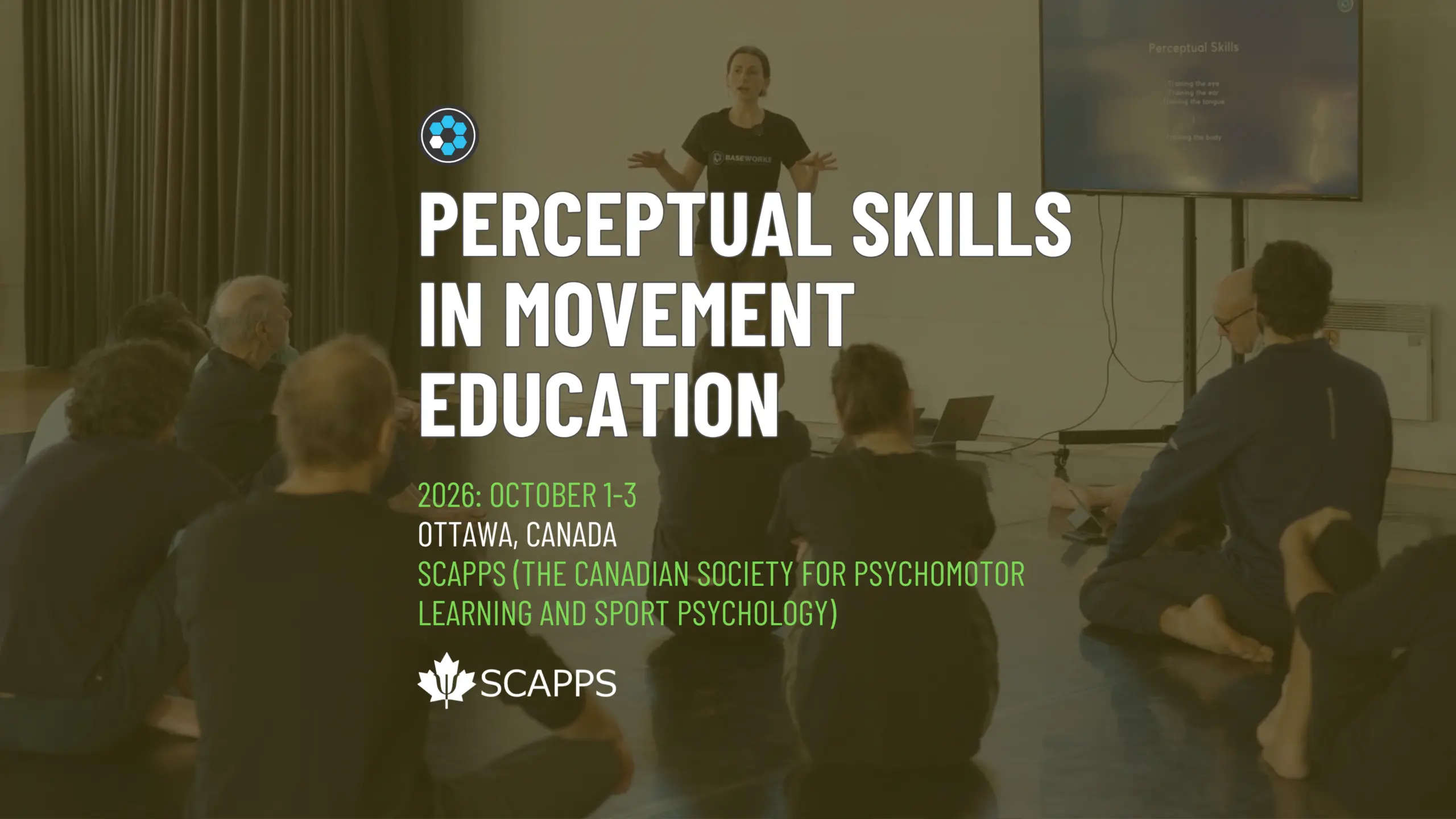
A presenter in a black Baseworks T-shirt stands at the front of a studio with arms open, speaking to a group seated on the floor with their backs to the camera, a screen titled Perceptual Skills beside her. Title text reads Perceptual Skills in Movement Education, 2026: October 1-3, Ottawa, Canada, SCAPPS (The Canadian Society for Psychomotor Learning and Sport Psychology).

Baseworks at SCAPPS 2026: Perceptual Skills in Movement Education

Baseworks director of research Ksenia Asia Shcherbakova will present a poster at the 2026 Annual Conference of the Canadian Society for Psychomotor Learning and Sport Psychology (SCAPPS) in Ottawa, October 1 to 3, 2026. The poster is titled “Perceptual Skills in Movement Education: Discrimination as a Prerequisite for Appraisal and Behavioural Change.” Baseworks founder Patrick

Dive deeper »
drawing of a piano keyboard with the names of muscles on each key.

Muscle Key-Board

It’s a misconception that the motor cortex controls muscles like a keyboard. But in Baseworks practice, we are trying to use it more like a keyboard, making motor learning easier.

Dive deeper »

Distributed Activation: the M1 on Fire

This article is about a common misconception that the brain contains a “motor map” of our muscles in the same sense we usually think about maps (one-to-one representation). It further explains the term “distributed activation” in movement research and then compares it with the Baseworks Distributed Activation.

Dive deeper »