

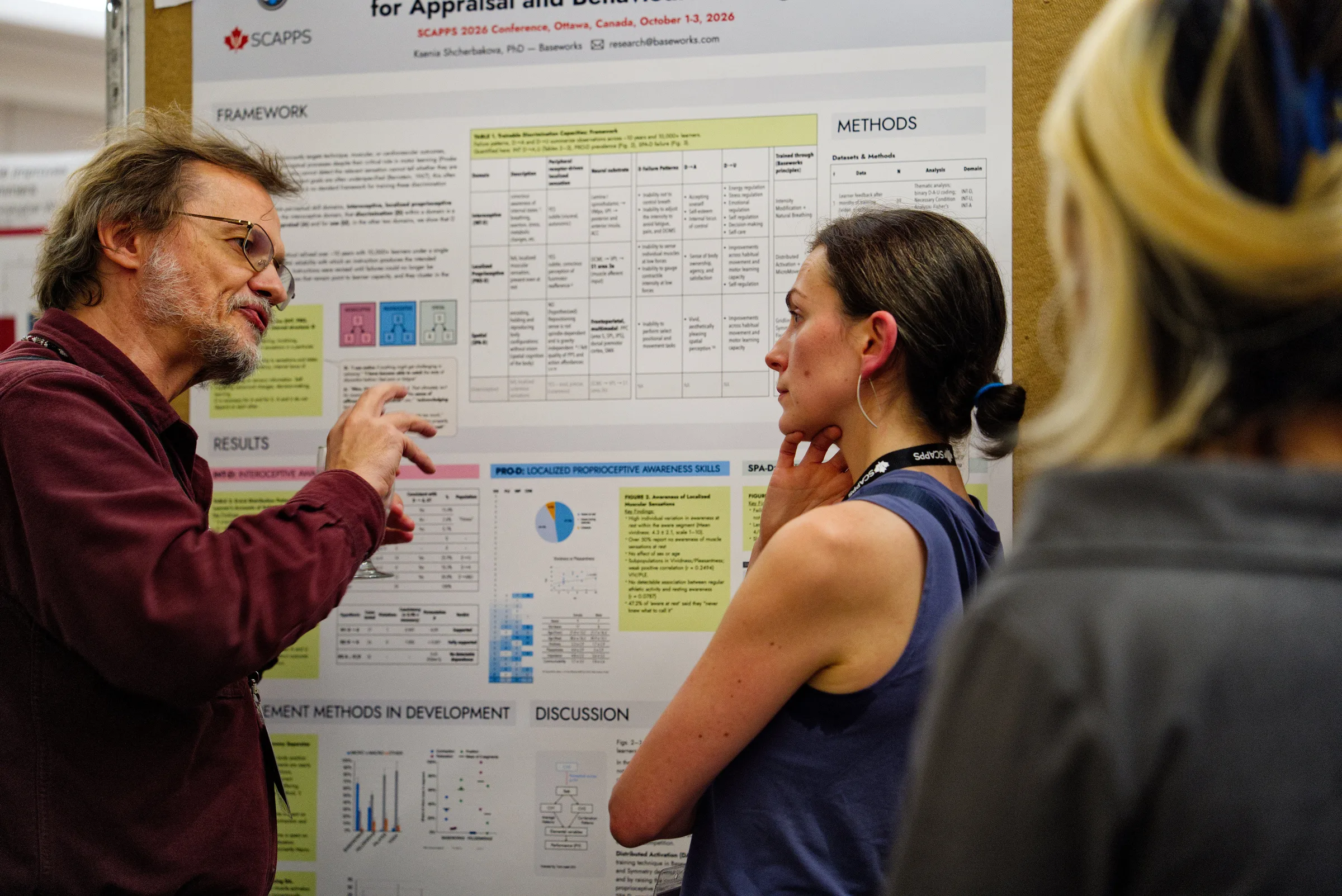
From October 1 to 3, 2026, we attended the annual conference of the Canadian Society for Psychomotor Learning and Sport Psychology (SCAPPS) in Ottawa, where Ksenia Asia Shcherbakova presented a poster titled “Perceptual Skills in Movement Education: Discrimination as a Prerequisite for Appraisal and Behavioural Change.” SCAPPS is the Canadian society for research in motor control, motor learning, and sport and exercise psychology. The 2026 meeting took place at the Delta Hotels Ottawa City Centre, with support from the University of Ottawa and other organizations. We announced the presentation in an earlier event post. This is an account of what we presented and what we saw and heard, with a reflection on where we stand in relation to the field.
The Baseworks Poster
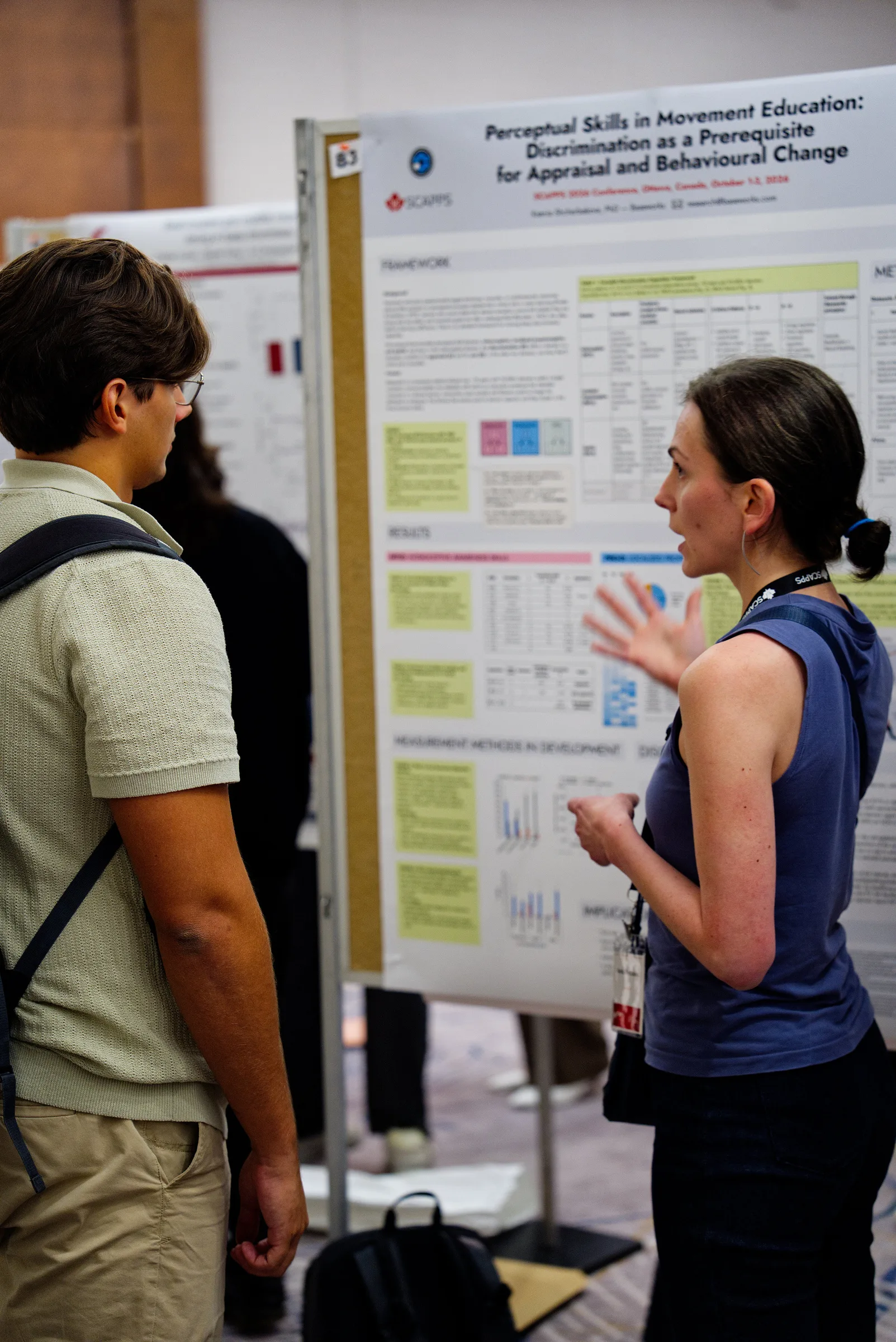
In our poster, we propose that the sensing a learner relies on to follow a movement instruction can be understood as a set of skills that can be developed. Our framework of three perceptual skill domains draws on about ten years of refining the Baseworks Method with 10,000+ learners. This refinement was guided by a single requirement: an instruction had to produce the intended movement reliably across a diverse group of people. The instances where instructions kept failing, after the wording had been ruled out as the cause, fall into three distinct classes, corresponding to the three domains.
Interoceptive. Conscious awareness of internal states such as breathing, exertion, and stress.
Localized proprioceptive. Felt, localized sensation from the muscles, present even at rest. In our survey of 36 people, most of them with no Baseworks experience, more than half reported no awareness of muscular sensation at rest, while a substantial proportion did. We also found no association between that awareness and regular athletic activity.
Spatial. Encoding, holding, and reproducing a body configuration without looking. On selected positional tasks, people new to Baseworks showed errors 8 to 15 times larger than people with Baseworks experience. When we tracked learning progress within one group, the share of participants performing a task correctly rose from 8% to 36% over seven sessions. This means that the movement tasks we work with in Baseworks require something that explanation alone cannot provide and that develops over time: the perceptual skills in question.
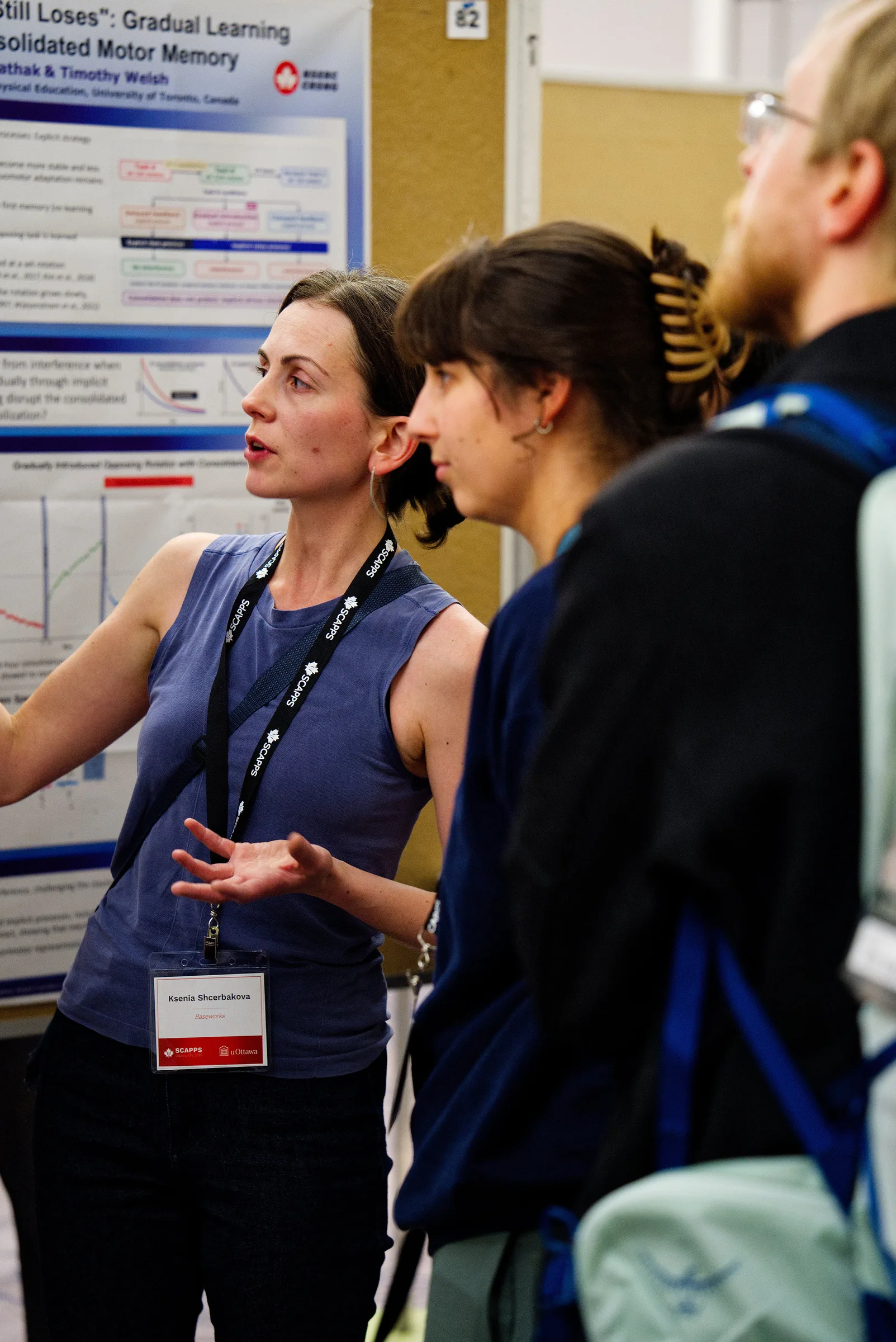
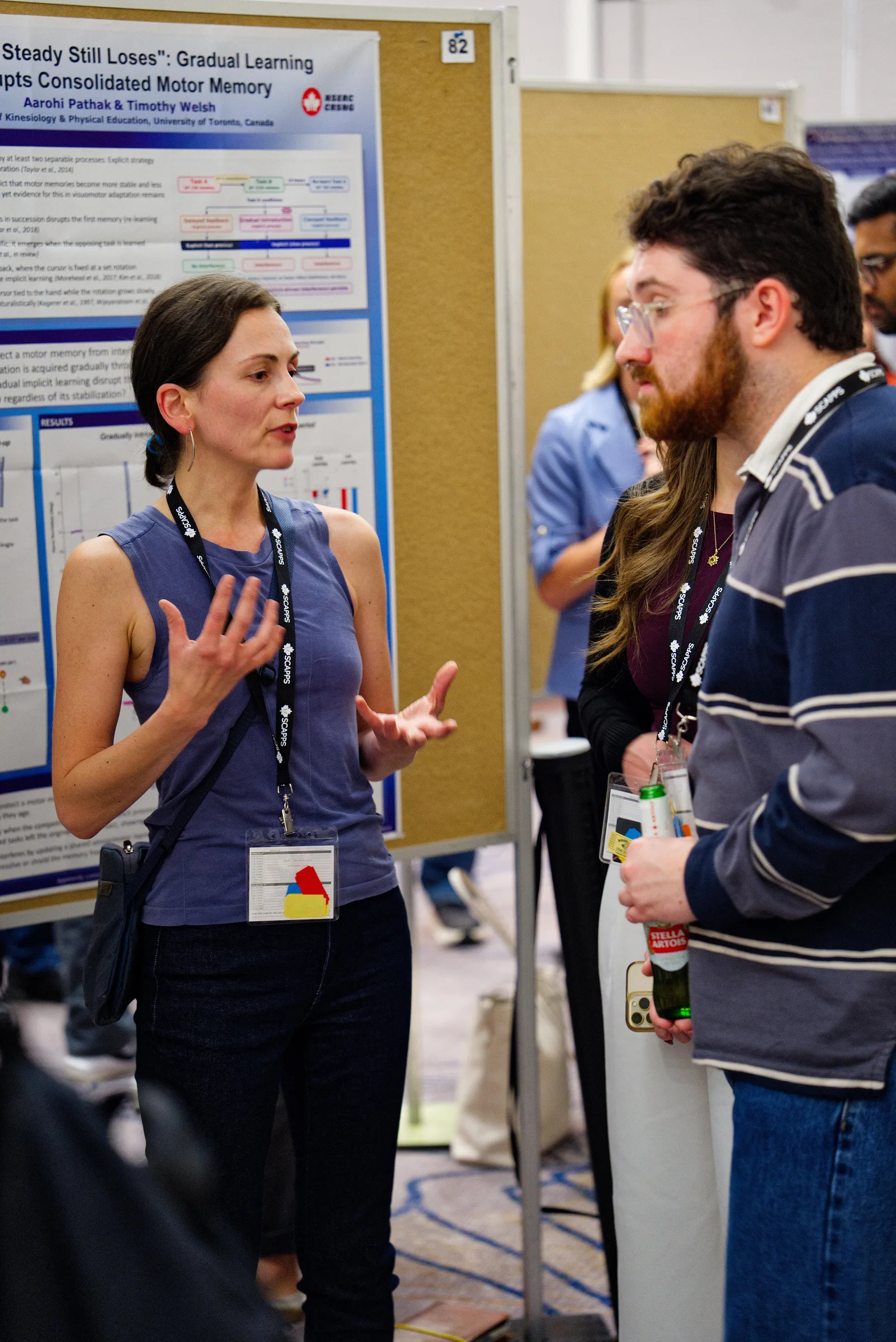
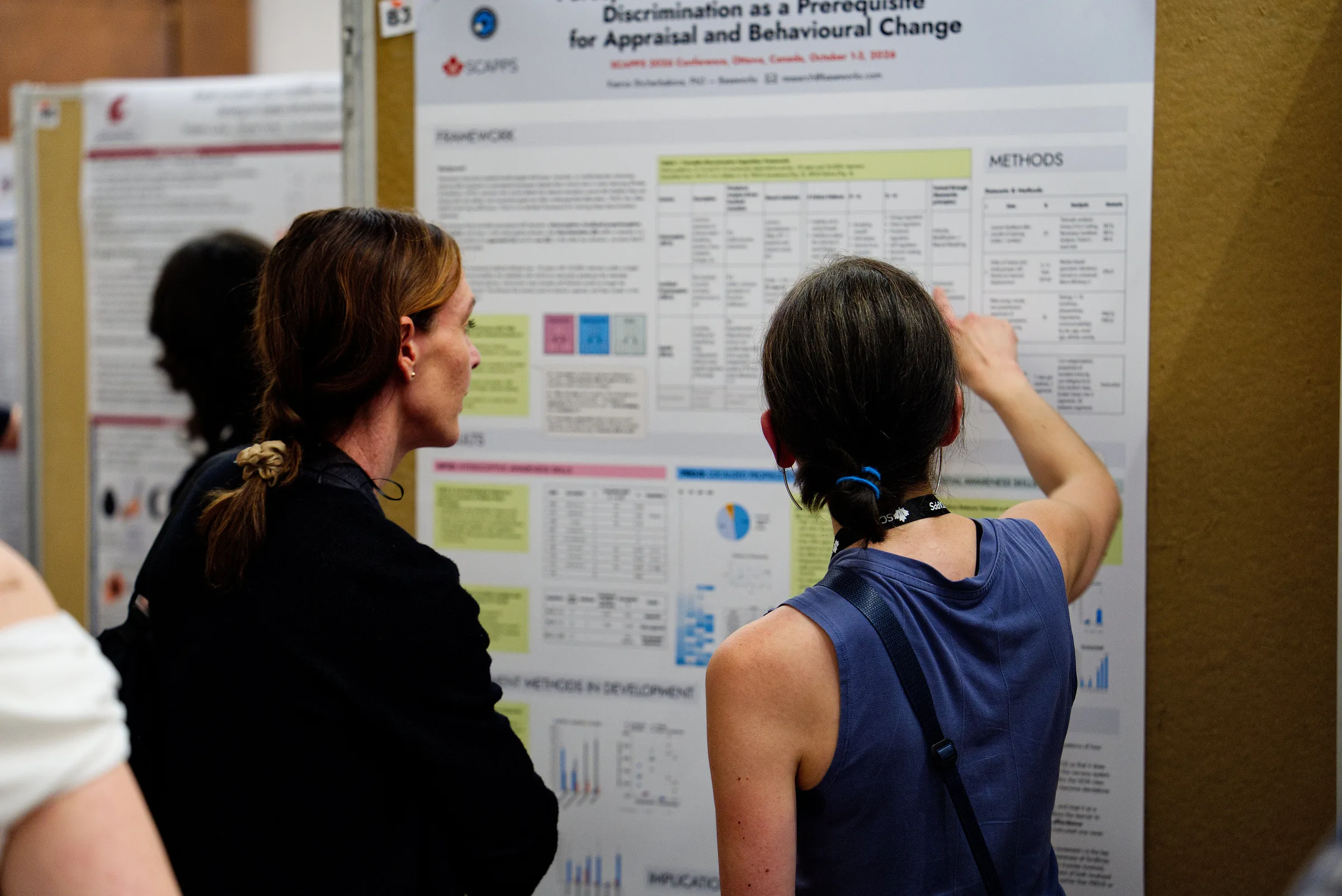
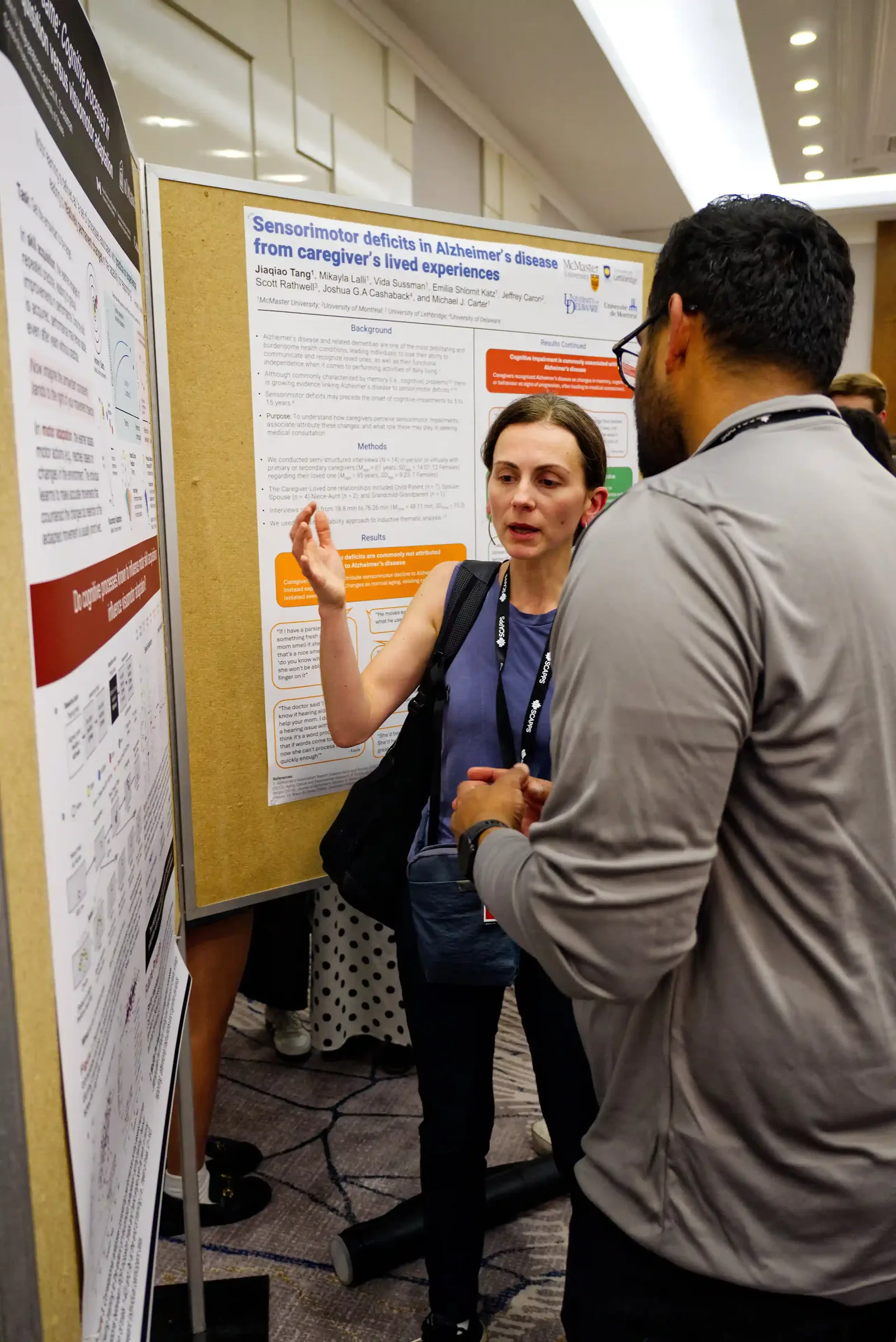
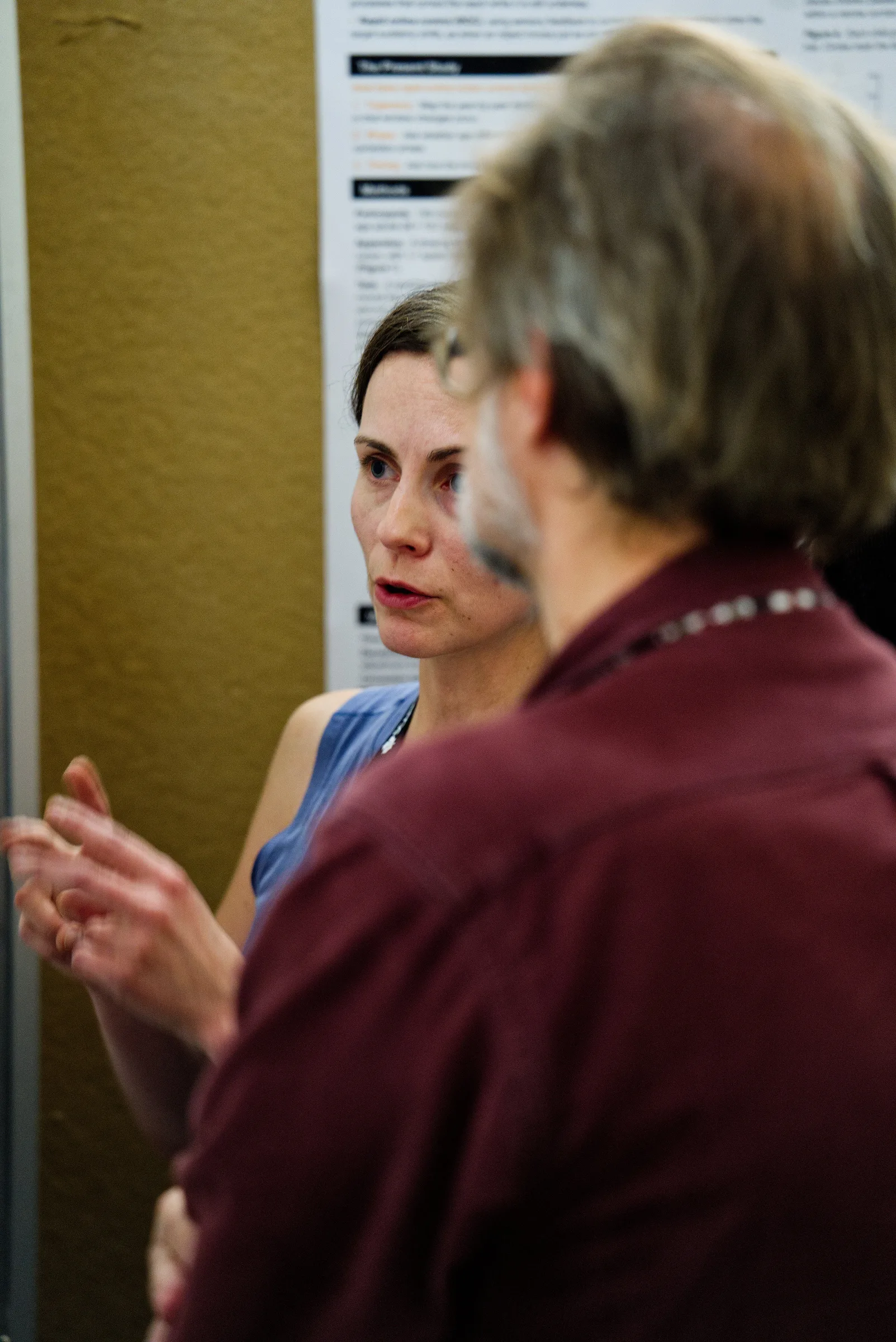
Poster session, Friday, October 2.
Within each domain, we distinguish three dimensions. Discrimination (D) is detecting and localizing sensations and judging their intensity. Appraisal (A) is the person’s relationship to those sensations and states: trust, acceptance, an internal sense of evaluation. Use (U) is acting on sensory information: self-regulation, decisions, learning.
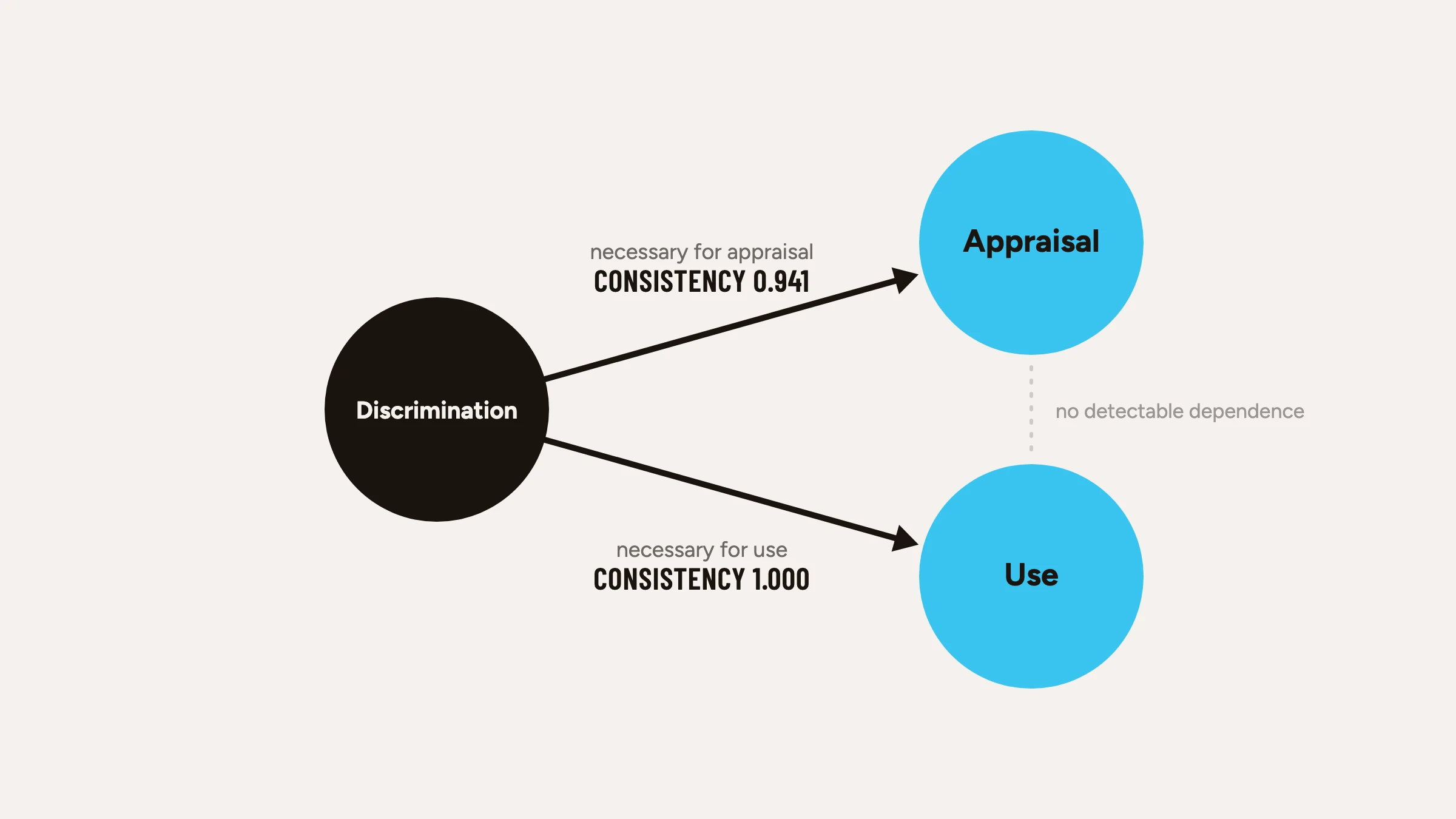
One of the main findings concerns how the three dimensions relate. We coded written and video accounts from 39 learners, given after days, weeks, or months of practice, for the presence of D, A, and U in the interoceptive domain. Necessary condition analysis supported discrimination as a prerequisite for appraisal (consistency 0.941) and for use (consistency 1.000). Notably, appraisal and use showed no detectable dependence on each other. Some learners described discrimination and appraisal, some described discrimination and use, and some described all three. Our data suggest that developing discrimination is a prerequisite for developing appraisal or use. In the localized proprioceptive and spatial domains, our data show that discrimination varies widely between people and changes with practice, with progress often taking several training sessions.
We also presented a typology of instructions based on a metric that is relevant in Baseworks and shows distinct patterns across methods. We compared the spoken instructions in one class each of Baseworks, Feldenkrais, Pilates, and yoga; for the last three, we took the top YouTube result for “[method] class.” Two thirds of the instruction time in the Baseworks class and one third in the Feldenkrais class went to what we call “micromovements”: cues for movements that are nearly invisible from the outside, such as isometric contraction, relaxation, or reconfirming a position. The yoga and Pilates classes gave less than 5% of their instruction time to these details. Within the micromovement cues, the Feldenkrais class had a 3:1 ratio of relaxation to position, and the Baseworks class a 2:1 ratio of contraction to position.
The conversations in front of our poster primarily revolved around the technique of Distributed Activation and our definition of proprioceptive awareness as opposed to spatial awareness. One of the motor control researchers commented, “Essentially, you’re breaking synergies,” which is a concise and elegant way of capturing what the principle of Fixing-Separating-Isolating is all about.
The Field at SCAPPS
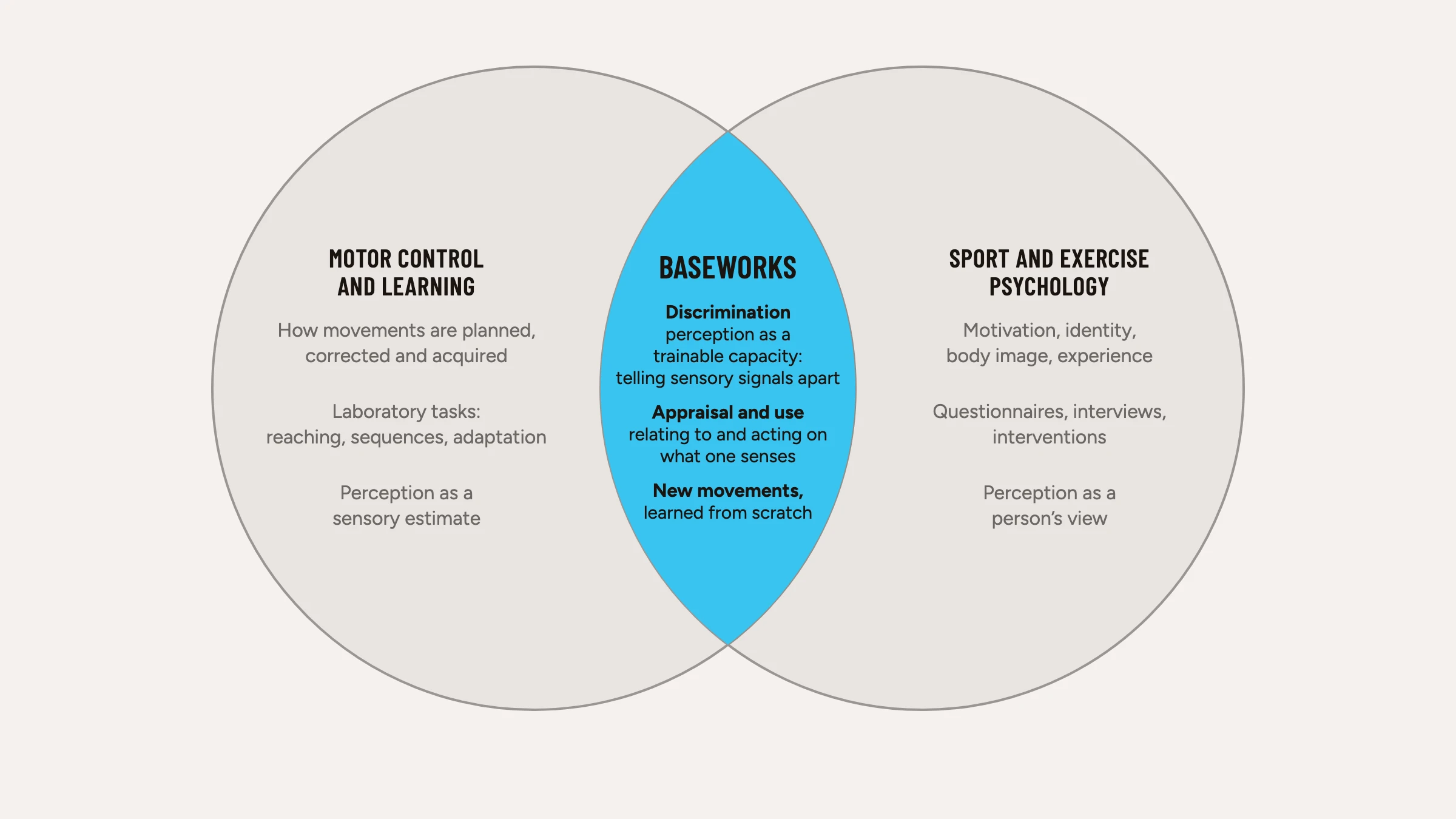
SCAPPS brings into one meeting three research communities that occupy two very different poles. One studies motor control and learning (MCL): how movements are planned, corrected, and acquired, usually through controlled laboratory tasks. The other studies sport and exercise psychology (SEP): motivation, identity, group dynamics, body image, and the experience of physical activity, through questionnaires, interviews, and interventions. Sport psychology and exercise psychology are closer to each other than to motor control, but they serve two different populations: competitive athletes and the general public (people who are physically active and people who are not). Sessions ran in parallel through all three days. The three keynote speakers were Dr. Paul Cisek (Université de Montréal) for motor learning and control, Mark Beauchamp (University of British Columbia) for sport and exercise psychology, and Tricia McGuire-Adams (University of Toronto), whose keynote was titled “Enacting Indigenous health resurgence.”
The society addressed its own structure during the Interdisciplinary Forum, “Interdisciplinarity as ‘value-added’ in a specialized academic world,” chaired by David J. Hancock (Memorial University of Newfoundland), where a panel of researchers from both communities (MCL and SEP) discussed how questions that sit between the two get asked and answered. They explicitly addressed “the gap” between the two communities, in their research methods and in the questions they seek to answer.
Our poster was assigned to the motor learning stream, but its subject touches both communities: the data are about perception and movement, and the outcomes learners describe reach into self-regulation and how they relate to their own bodies.
Research Worth Noting
Here is a brief overview of a few presentations that were especially insightful in relation to what we do in Baseworks.
From motor control and learning
Darrin Wijeyaratnam and Erin K. Cressman (University of Ottawa). “Not quite the same: Cognitive process in skill acquisition versus visuomotor adaptation.” In the study, participants made fast reaching movements toward a target on a screen. They couldn’t see their hand, and a cursor on the screen showed where it was. At some point during training, the cursor was rotated by 40 degrees, so hitting the target meant learning to aim off to one side. The authors tested three ways of engaging cognitive processes during this task: choosing the target, reporting a movement strategy, and focusing attention on either the cursor (external focus) or the hand (internal focus). Focusing on the path of the hand, which participants could feel but not see, improved adaptation during training more than focusing on the cursor. The authors note that this runs against the advantage of an external focus usually reported in skill acquisition research (Wulf, Lauterbach and Toole, 1999). In a related paper published this year, the authors suggest that the internal focus may have enhanced the processing of proprioceptive information from the hand, and that an internal focus may be beneficial in some tasks.
→ This research is in line with our observations in Baseworks, especially since we don’t typically use an external focus. In many Baseworks tasks, directing attention to internal sensations and enhancing them through Distributed Activation improves learning.
Gabriela Oancea and Luc Tremblay (University of Toronto). “Metacognitive evaluations modulate trial-to-trial error correction.” In this study, participants reached toward a target again and again. After each trial, they judged whether they had overshot or undershot and rated their confidence in that judgment, then corrected themselves on the next trial. The authors found that the adjustment on the next trial was strongest after a correct, high-confidence judgment and weakest after an incorrect, high-confidence one.
→ This is close to a question at the center of our poster: an error can inform the next movement only to the degree that the person perceives it accurately.
Kyle Vallido, Nicola Hodges, and Sarah Kraeutner (University of British Columbia). “No action required: Investigating the extent to which motor learning occurs through different types of covert practice.” Can you learn a movement without performing it? In this study, participants new to the task learned a joystick movement sequence without moving the joystick. One group imagined what the movement would look like (visual motor imagery), another imagined what it would feel like (kinaesthetic motor imagery), and a third watched it being performed (observation). Imagining the movement improved performance more than watching it. Imagining how it feels improved performance more than imagining how it looks.
→ This is another presentation at SCAPPS this year showing that, in some tasks, you improve more when you focus on what the movement feels like than on what it looks like (which is, essentially, one of the Baseworks taglines).
From sport and exercise psychology
Eva Pila, Samantha Adler, and Rachel Calogero (Western University). “State Embodied Movement: Introducing a Novel Construct and Testing a Momentary Instrument.” How present are you in your body while you’re being physically active? Pila and her colleagues set out to measure it. They define “state embodied movement” (SEM) as a subjective experience of being physically and psychologically engaged with the body during physical activity. In the talk, Pila explicitly distinguished SEM from mindfulness and from the experience of embodiment. SEM includes noticing your body, responding to its sensations, a sense of agency, and being absorbed in the movement. They created and tested a short questionnaire that can be answered several times during a single bout of physical activity.
→ The SEM scale is a metric that has not existed in research before. Its value can change during a single bout of activity. A higher score on this scale also traces the experience side of the appraisal and use skills that we train in Baseworks.
Derrik Motz (University of Ottawa), Scott Rathwell (University of Lethbridge), and Bradley W. Young (University of Ottawa). “A critical realist exploration of athletic identity across three successive adult age cohorts using elaborative think-aloud interviews.” What does it mean to be an athlete at 30, at 45, or at 70? The authors interviewed adult athletes from three age groups. Participants read questionnaire statements aloud and talked through what each one brought up. Young adults were redefining what counts as being an athlete, measured against standards carried over from youth sport. People in midlife were balancing their athletic identity against career and family. Older athletes protected it against aging by telling a continuous life story of meaning and capability. The authors describe athletic identity in adulthood as ongoing, active work. The slides and the wider project are on Derrik Motz’s research page.
→ Two things interested us here: adults who sustain a physical practice over decades, and a way of using a questionnaire to draw out a person’s own account.
Dr. Paul Cisek’s Keynote: “The Blurry Borders Between Deciding and Acting”
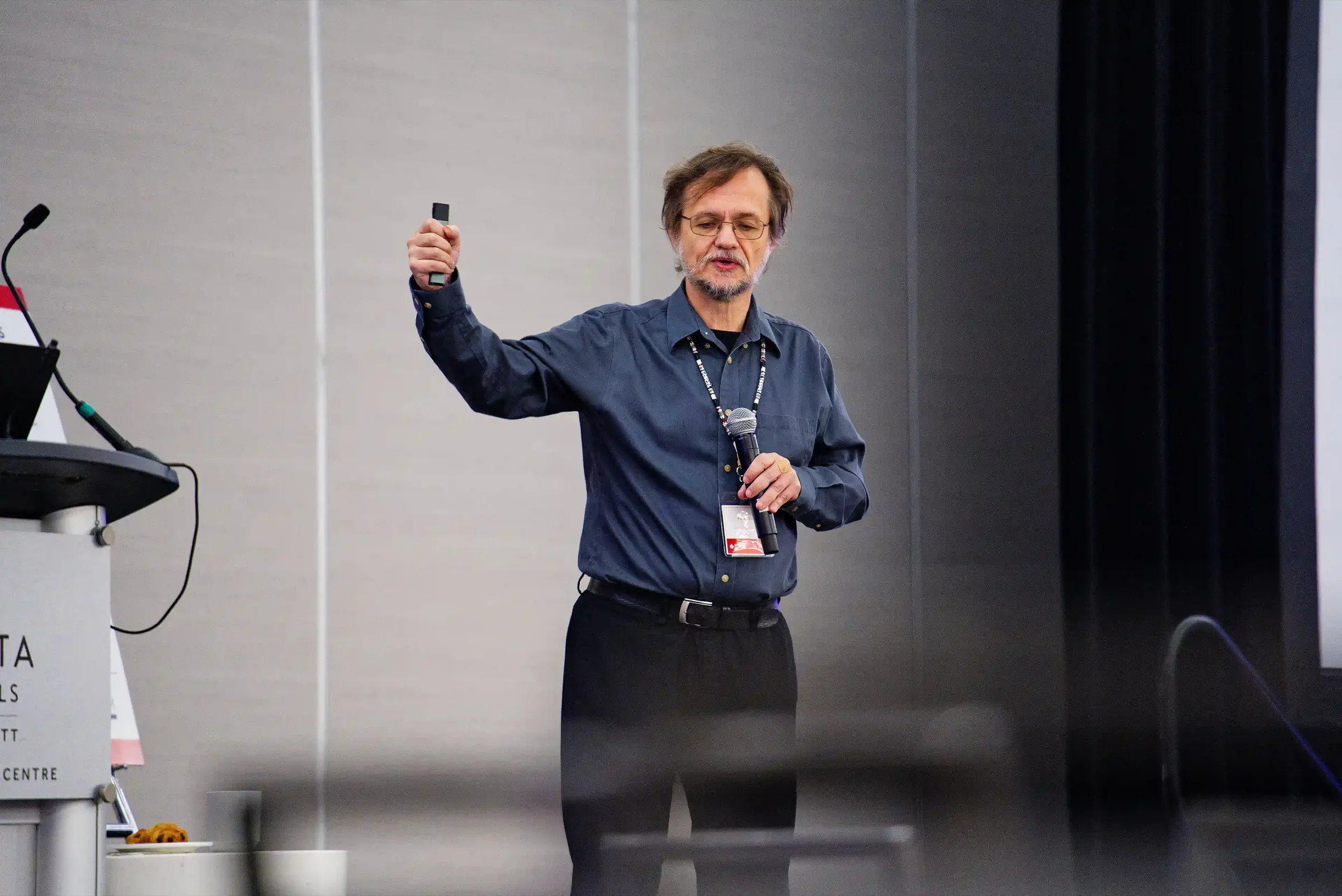
Dr. Paul Cisek’s keynote started from two slides: one showing two players contemplating the board during a game of chess, and another showing a leopard watching a herd of zebras next to a photo from a hockey game. These slides illustrated the split between the “classical view” of decision-making and the one Dr. Cisek himself, along with many other motor control scientists, has developed over two decades.
In the classical picture, a decision is made first and an action is planned and executed afterward. Dr. Cisek’s affordance competition hypothesis proposes that the brain continuously specifies the actions currently available to it and selects among them while behavior is under way. Recordings from his lab and others’ show activity related to a decision in the same sensorimotor regions that prepare and control movement.
In later work with Giovanni Pezzulo, he describes behavior as feedback control: available actions compete, and the selection is biased by predictions of their outcomes and of the new opportunities for action they will open. As the title says, the keynote extended this to decisions made in the middle of an ongoing movement, where deciding and acting are hard to separate.
Someone who follows popular science communication may have absorbed a worldview in which the prefrontal cortex (PFC) makes decisions and the motor areas simply send out commands to muscles. In a worldview like Dr. Cisek’s, shared by many in the field, the PFC provides context, but the commitment to action actually happens within the sensorimotor system. We largely share this view and believe that anyone interested in “embodiment” should pay attention to it.
Our poster cites the affordance competition hypothesis as one of its key references, but we take an additional step. In Dr. Cisek’s account, the actions available to a person are set by the layout of the environment and by the person’s existing motor capacities. In Baseworks, we work with a further condition. A movement instruction often specifies something the learner has to sense in order to be able to do it. For example, to follow the instruction “keep the spine straight,” a learner has to be able to tell whether their spine is straight. When the learner cannot yet perceive that variable, the instructed action is not among the options available for selection, and the sensorimotor system selects a habitual movement. The discrimination capacity described in our poster thus makes an action available for selection. It creates new affordances that can then compete with each other.
In making this extension, we should note that Dr. Cisek’s experiments generally use visual targets and reaching movements, where the options are plainly visible. We are applying the idea to proprioceptive and interoceptive information, which may take training to access.
Motor Learning Research vs Skill Acquisition
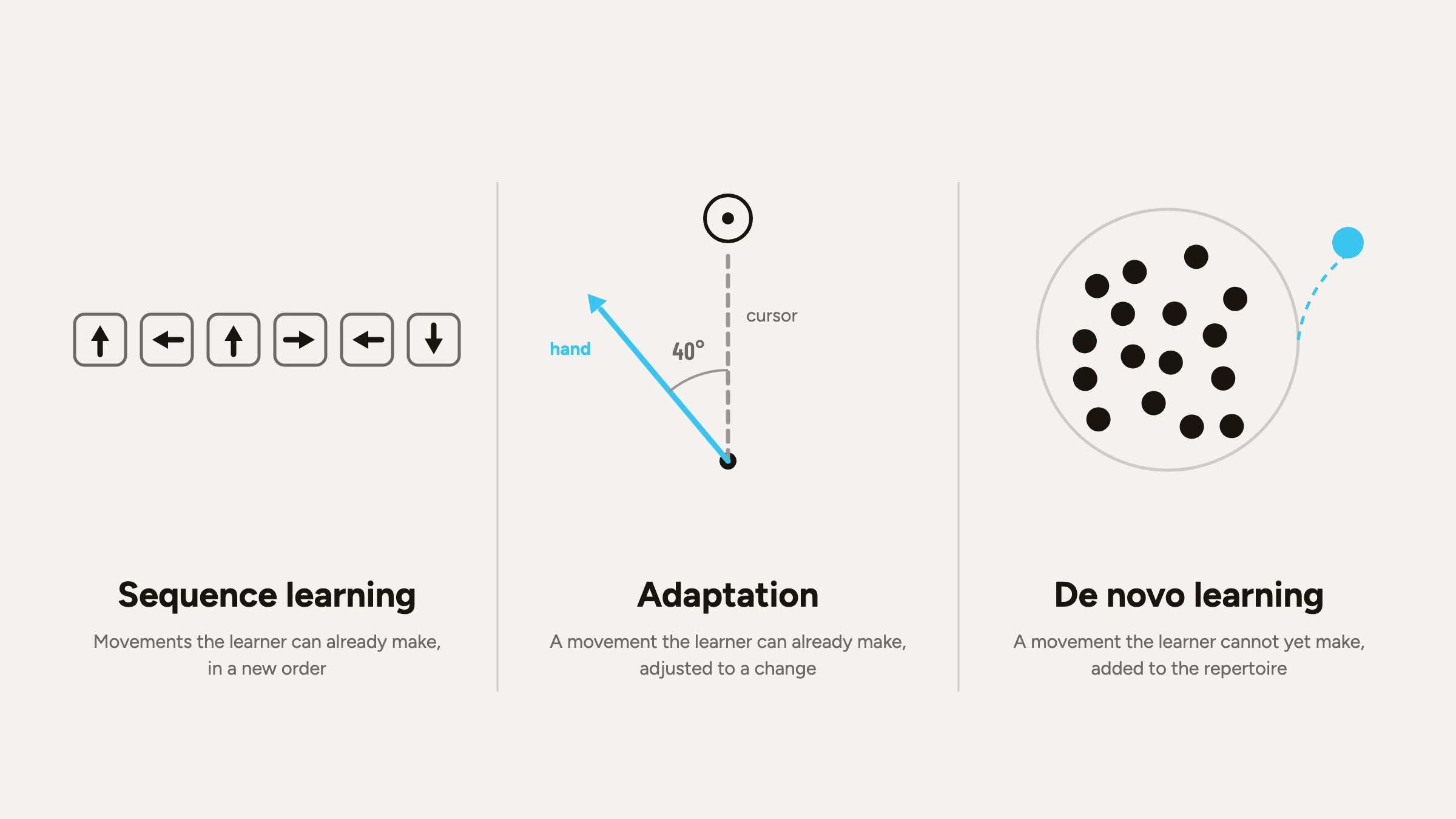
Coming to SCAPPS with our background and the kinds of problems we solve, we noticed that most of the motor learning experiments we saw used sequence learning or adaptation tasks.
- Sequence learning examples: learning a sequence of joystick moves (up, left, up, right, left, down); learning a sequence of keys on a keyboard (F G H F J F).
- Adaptation examples: learning to reach toward a target when your hidden hand is shown as a cursor on a screen and the cursor is then rotated; learning to reach toward a target while a robotic arm pushes your hand from the side.
In all these cases, the task is clear, it is evident whether a trial failed, and participants already know how to reach with their hand, use a joystick, or press a key.
Conversely, in Baseworks we often work with tasks that look very simple but put learners in a position where they say, “I can’t feel at all what I am doing,” “I don’t know whether I am doing it right,” and “I don’t understand what exactly I am supposed to do.” Importantly, Baseworks tasks weren’t invented by experimenters. They were selected by the requirement that instructions work reliably.
Our tasks, especially for learners who still fail at them, are probably better understood as de novo skill acquisition. Krakauer et al. (2019) draw this distinction in their review of motor learning paradigms. They conclude that adaptation and sequence learning “fall short” as models of skill acquisition: adaptation adjusts movements people already make well, and sequence tasks put existing movements in a new order. Acquiring a new skill, they write, often requires learning “a novel feedback controller from scratch.” They also note that de novo learning can involve two distinct processes: “(i) learning to select an existing action under different circumstances than before, and (ii) broadening the repertoire of available actions.” Baseworks works mostly with the second.
Krakauer et al. base the (i)/(ii) split on Sadtler et al. (2014), “Neural constraints on learning,” from Aaron Batista’s lab, a line of work we were pointed to in a conversation at our poster. When the monkeys in Sadtler’s study had to produce activity patterns outside their usual repertoire, learning was, in Krakauer et al.’s summary, “much slower and less complete.” That is consistent with how long Baseworks tasks take to learn and how often learners fail at them at first.
Krakauer et al. map continuous de novo learning mostly onto action selection, with smaller contributions to goal selection and execution. In Baseworks, we place more weight on goal selection, that is, where to move or what to act on. In the terms of Dr. Cisek’s affordance competition hypothesis, discussed above, an action that isn’t specified can’t enter the competition, and an action can’t be specified if a learner can’t perceive a body part and its position. Hence, training the capacity to perceive comes to the forefront in Baseworks.
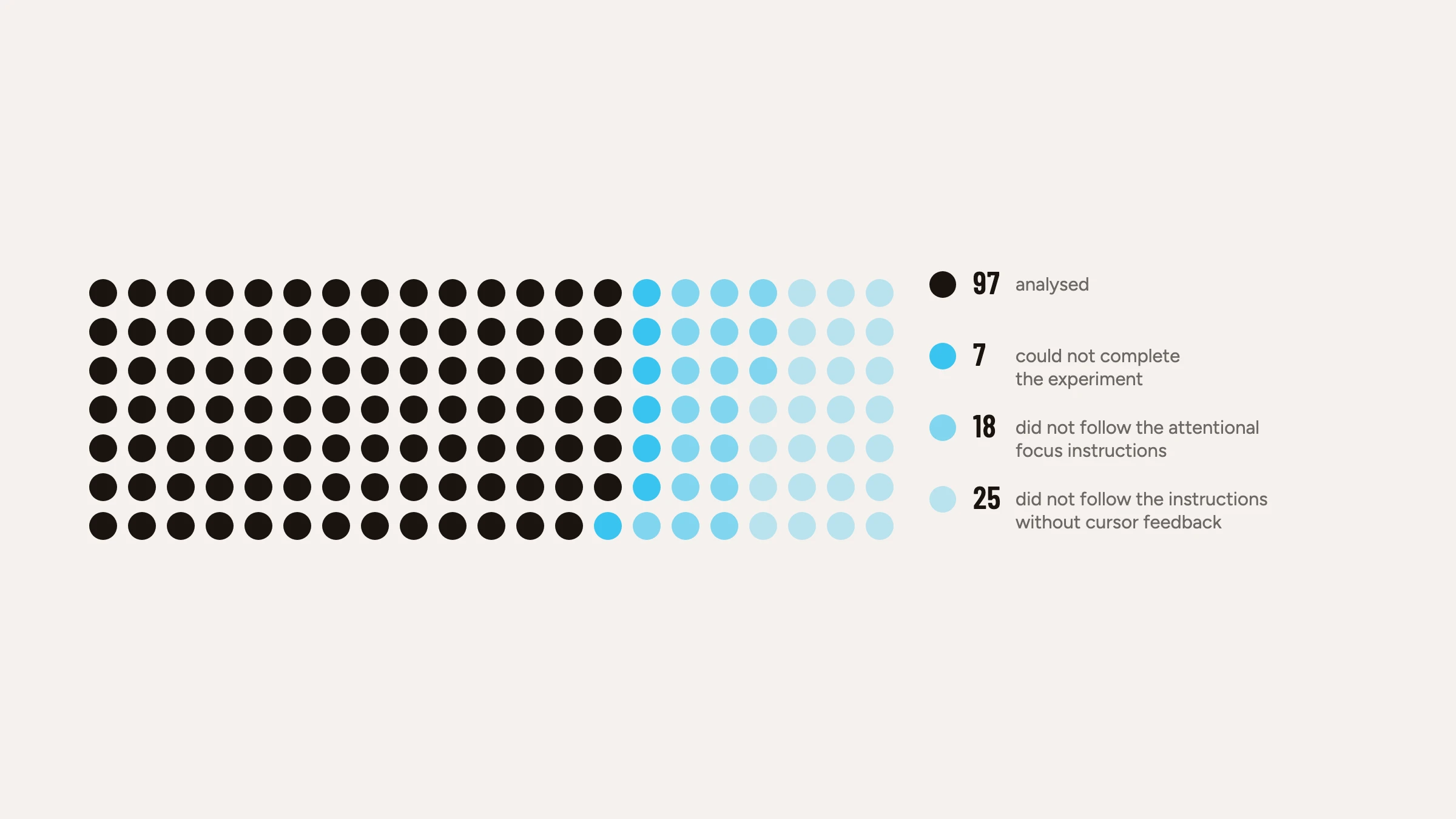
In the published study by Wijeyaratnam and Cressman mentioned above, 50 of 147 enrolled participants were excluded from analysis: 7 were unable to complete the experiment, 18 didn’t follow their attentional focus instructions, and 25 didn’t follow the instructions in the assessment trials without cursor feedback. A third of the participants didn’t do what the task asked. Excluding them is standard practice, but what is excluded as noise there is what we study. In Baseworks, we often see a third of learners or more fail at a task that looks simple. Over ten years and 10,000+ learners, Baseworks instructors focused on these failures, documenting, discussing, observing, and systematically adjusting the cues and the movements themselves. That process selected the tasks that teach learners to feel what their bodies are actually doing.
Two Meanings of Perception
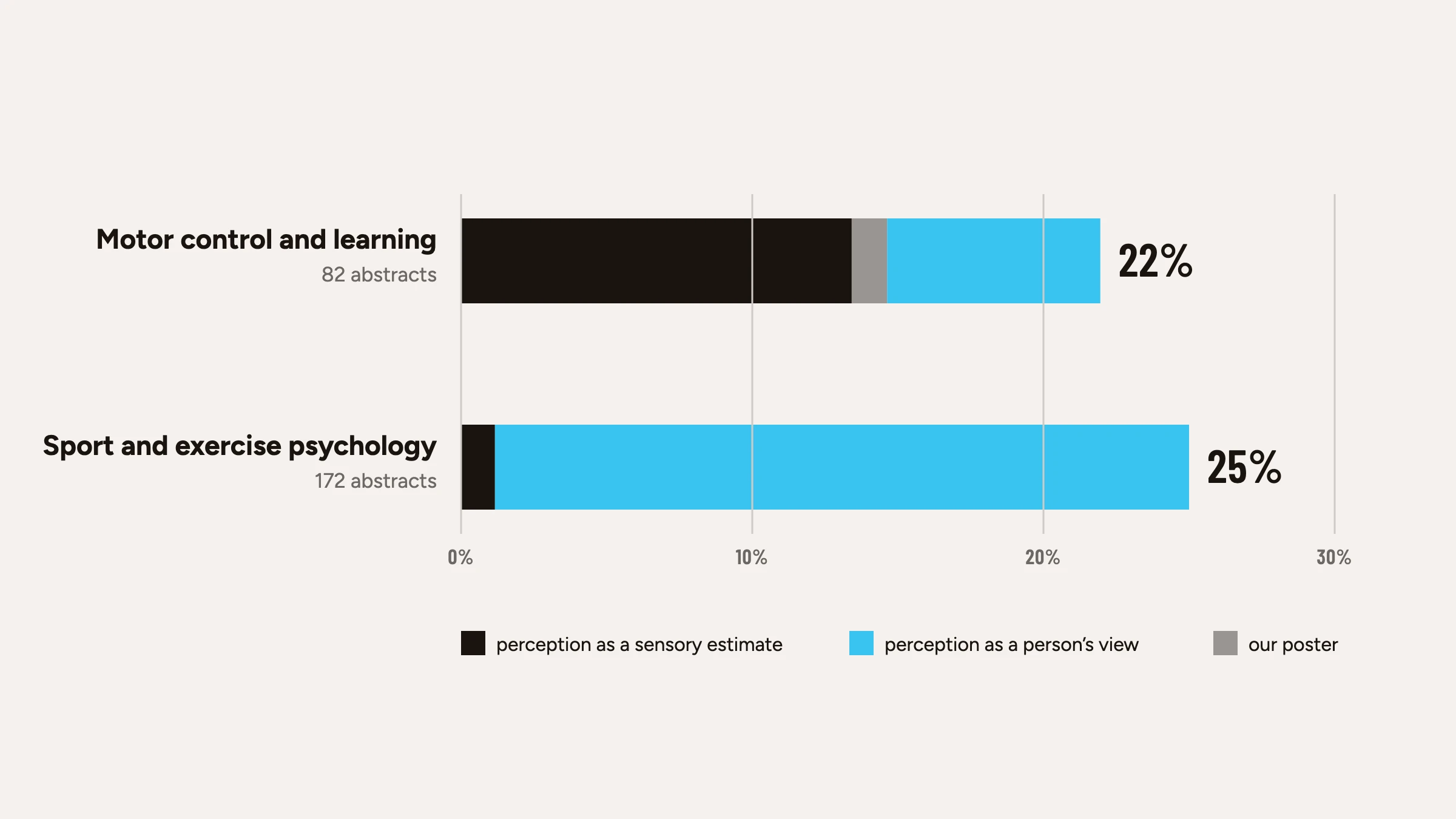
After the meeting, we looked at how the different research communities used the word “perception” in the conference abstract book. It appeared in 22% of MCL abstracts and 25% of SEP abstracts. What’s interesting is that it was used with different meanings. In motor control and learning, this word usually refers to a sensory estimate: where an unseen hand is, whether a delay occurred, measured with pointing or forced-choice tasks. In sport and exercise psychology, it usually refers to a person’s view of something: a coach, a mentoring relationship, a gym, their own performance, gathered through questionnaires and interviews. Our poster needs both meanings. Discrimination is perception in the first sense, applied to one’s own body. Appraisal is close to the second: a person’s relationship to what they sense. In our data for the interoceptive domain, changes in the second rarely appeared without changes in the first. That link is the question we’d most like to explore with researchers from both sides.
We thank SCAPPS and its organizing committee for hosting the 2026 meeting, the University of Ottawa and the other organizations that supported it, and everyone who stopped at our poster.



 Apple Podcasts
 Spotify
 Overcast
 Castro
 Amazon Music
 CastBox
 YouTube
 RSS
RSS Goodpods
 iHeartRadio