
There is a verb for sharing what you see: “look at that.” There is one for hearing: “listen to this.” For smell and taste, there’s “smell this” and “taste this” as you hand someone the object you want them to inspect. For the sense of your own body in space, there is nothing to hand over, and “feel this” doesn’t work because this will be pointing inward for two different bodies.
I started thinking about this after reading a piece in the Guardian on the power of proprioception. It’s a good article. It explains that proprioception is the sense that tells you where your limbs are, that it tends to decline with age, that standing on one leg is a reasonable way to maintain it, that athletes on average do better at this than the rest of the population, and that parkour is a more demanding version of the same idea. Everything in it is accurate. It also carries the same implicit attitude as almost every article I’ve read about proprioception in the general press: that it is a sense you don’t need to think about until it starts to fail.
Reading that article, I thought to myself: nobody would write that way about vision. And the reason why is worth its own post.
So, this post is a thought experiment: what would that same article look like in a world where people wrote about vision the way our culture writes about proprioception? I invite you to participate in it with me.
The Thought Experiment: A World That Never Needed to Look
In 1904, H.G. Wells wrote “The Country of the Blind,” where a sighted man enters a valley that has been blind for fifteen generations.
In our experiment, we will be less radical. Let’s imagine a parallel universe that is close to ours, where nobody’s fully blind, but vision is only used for navigation and basic obstacle avoidance. The people there have the same eyes and the same brains as we do. The one difference is that, from birth, their environment never asked anything more of vision. Everyone can see an object at palm’s length. The dominant sensory channels are hearing, touch, and proprioception. Daily tasks and work tasks do not require high-acuity vision or peripheral vision. Small groups of people have trained stronger visual capacities, but those people are not a ruling class, magicians, or priests holding a monopoly over a rare resource—they are just people working unusual jobs.
Let’s read an article from that world. Of course, in that world, it came out as an audio piece, because nobody uses vision to read articles.
The power of vision: how to improve your sixth sense and become healthier and happier
Most of us take vision for granted, until age starts to take it away. Here’s what the science says you can do
You probably don’t think much about your vision. Why would you? For most of your life it just works, in the background, without you noticing, keeping you from walking into walls and helping you find the door. It’s only when things start to go wrong that most of us notice how much we rely on it.
“Vision declines measurably after the age of 40,” says Dr. Carla Hewitt, a perceptual health researcher at the University of Bristol. “By their sixties, most people have lost a good part of their functional navigation acuity, and they don’t notice until they start clipping doorframes.”
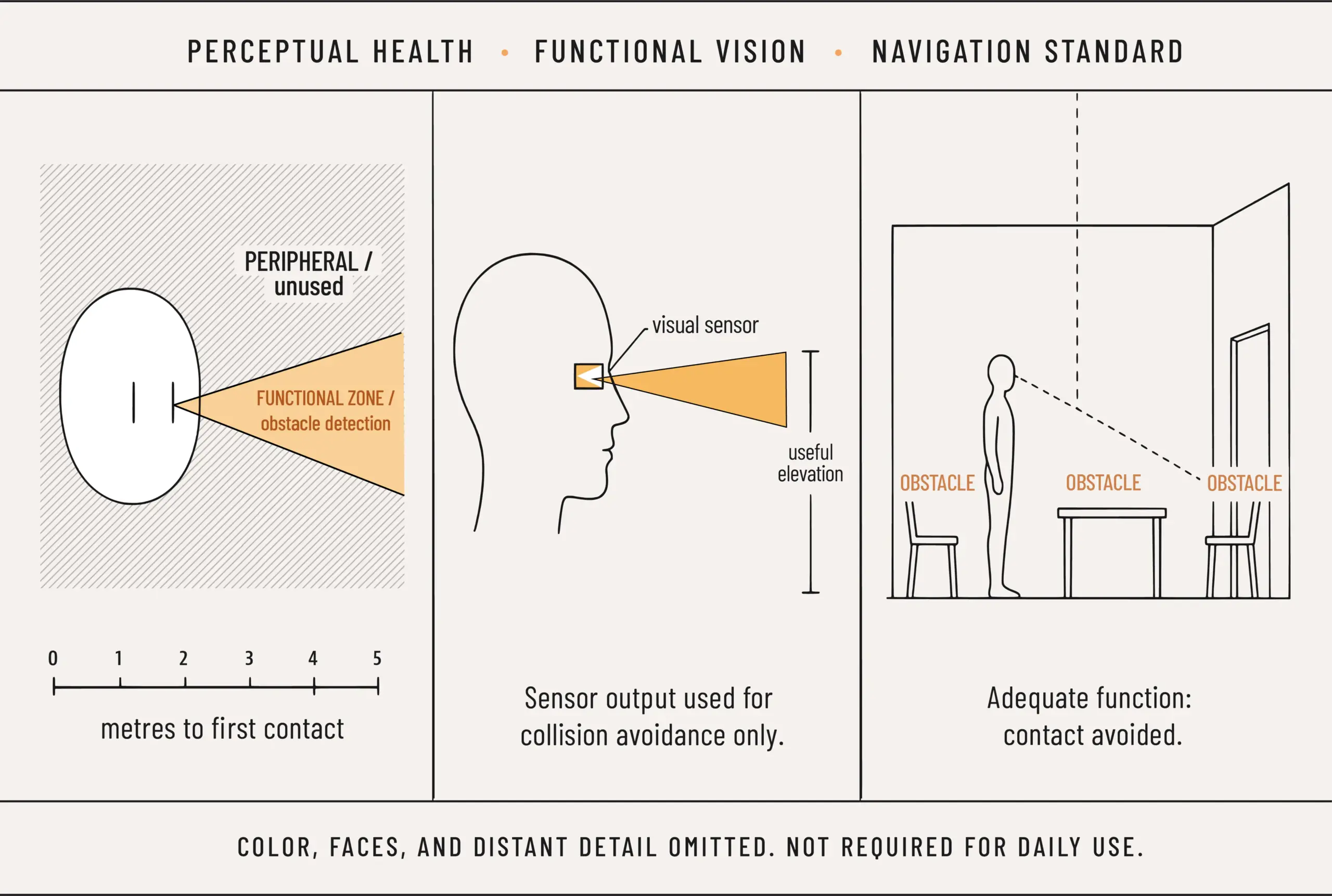
The good news is that there are simple things you can do to keep your vision sharp.
Start with the basics
The simplest exercise researchers recommend is known as directed looking: spending thirty seconds each morning deliberately focusing on a fixed point across the room. A study that followed four hundred adults over 55 for three years found that those who did this daily reported noticeably fewer collisions with furniture by the end of the follow-up period.
“It sounds almost too simple,” says Hewitt, “but most of us never consciously use our vision at all. We just let it run.”
What the research shows
Vision, like most senses, responds to use. A study from the University of Copenhagen compared the visual acuity of specialist workers, people employed in high-vision trades such as thread-threading and color demonstration, with a control group of office workers. The specialists detected obstacles at roughly twice the distance of the control group and were markedly better at telling two nearby objects apart.
The researchers were careful to note that it remains unclear whether this comes from innate ability or from the demands of an unusual occupation that typically begins in childhood. “These are exceptional individuals,” the paper notes. “The findings should not be generalized to the broader population.”
Could more complex activities help?
Some practitioners now argue for what they call enriched visual environments: deliberately cluttered rooms that require the eye to process more than a typical space demands. Early results are promising, though experts caution that this is considerably more demanding than directed looking and may not suit older adults.
“You don’t need to do anything extreme,” says vision therapist Tom Regan. “The goal is to maintain enough functional vision that daily navigation isn’t compromised. Anything beyond that is really a specialist interest.”
The bottom line
Vision is one of those things, like sleep or digestion, that we tend to appreciate only when it lets us down. The research is clear: a few minutes of simple visual exercise a week can slow the age-related decline that, left unaddressed, makes everyday navigation genuinely hazardous.
“We’re not asking people to become thread-threaders,” Hewitt laughs. “We just want them to be able to cross the road safely when they’re 75.”
Now replace “vision” with “proprioception” and “thread-threaders” with “gymnasts,” and you have the Guardian article.
Expert Senses Become Entertainment in Both Worlds
In Wells’s “The Country of the Blind,” the people of the valley treated the sighted man’s vision as a delusion. Our parallel universe is less different from ours, so expert-level vision is treated by the majority as a source of entertainment. People follow tournaments in thread threading and cheer for their favorite specialists who can distinguish between twelve shades of purple. They consume reports about visual performance through their dominant sensory channel—hearing.
This is not that different from our world, where people with expert proprioception—dancers, gymnasts, parkour athletes, circus artists—demonstrate an unusual sensory ability, and the rest of the population takes it in through the dominant sense, by watching.
“We’re not asking people to become thread-threaders” and “we’re not asking you to become a parkour athlete” are the same attitude toward a sensory capacity. In each case, the richer version of the sense has been assigned to a profession, fused with the movement skill, and what remains for everyone else is the safety category. In both worlds, the “normal” performance of a sensory capacity is reduced to fall prevention and obstacle avoidance.
Imagine you were able to travel to that world. You can see the sky, the faces of people, the flowers, the elaborate buildings designed for optimal acoustics—and you can’t discuss any of this richness with anyone, because the culture lacks the vocabulary for the visual properties that make the visual experience rich.
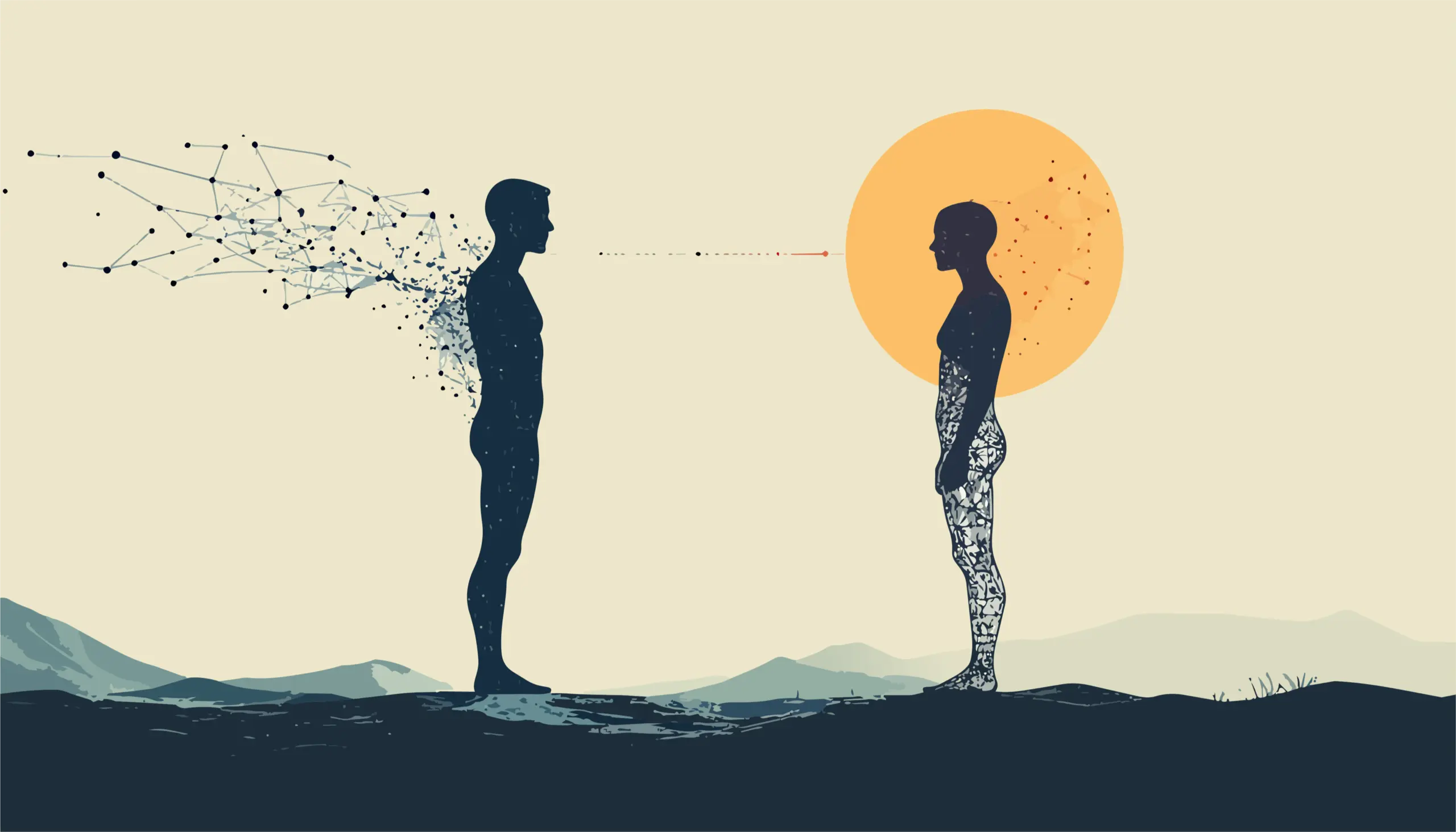
We could describe the difference between these worlds as having different “sensoriums”—the sensory domains that a culture or a group of people finds relevant and develops language and practices around. The “we” in “the way we write about proprioception” is cultural. The observation that Western culture is organized around vision is not new and has a well-established literature (for example, Martin Jay’s Downcast Eyes). This is also evident in everyday metaphors for knowing and understanding: “I see,” “insight,” a “clear view,” “throw some light on it.” And when someone sets out to explain a less familiar sense, they often reach for vision as a source of analogies. For example, Stephen McAdams introduces auditory grouping in his Sorbonne lectures on music perception with visual perspective illusions, as visual phenomena are much more familiar to the audience. In our sensorium, vision is the bridge everyone can cross.
Shared Vocabulary Exists to Appreciate Shared Objects
Why does a culture develop a rich vocabulary for some senses and not for others?
I think one of the key reasons for this is that shared vocabulary requires a shared referent—that is something that people can point at together. And different sensory channels are unequal in terms of the kind of referents they encode.
Music is one of the clearest cases illustrating this principle. Most people who love music have no technical vocabulary for what they love, and it doesn’t matter, because the referent is public. You can replay the part you mean. You can hum it. Share a time code or the corresponding line of lyrics. You can point at something and say, “This bit, here, I like it.” The technical vocabulary also exists (music theory is enormous), but it is optional for enjoyment, because pointing alone does the job. And a single song itself, or a single album can act as an external sharable referent. When people talk about music they normally don’t think of it as talking about hearing.
We could draw the same parallel with other senses. For example, olfaction. One doesn’t need technical vocabulary to enjoy wine—you can share a bottle. And sommeliers calibrate their terminology against shared samples. Nobody sips on wine and says, “I can taste and smell!” The conversation usually revolves around a particular texture of the sensory experience, with common vocabulary for different textures.
Proprioception is fundamentally different because the referent is private. There’s nothing to build a shared vocabulary around. I can’t tell you, “Hey, feel how the weight travels through my body as I move like this.”
Shared Vocabulary Exists to Keep People Safe
Another important reason to have a shared vocabulary for sensory objects is safety.
Every sense has safety-related textures that people learn to commonly recognize: rotten, bitter, too hot, too loud. These words help us use our senses to avoid injury, danger, and harm.
This kind of vocabulary exists for proprioception too. And for the sense of the body in space, the common safety-related textures are balance and falling.
So, with no shared referent, the words a culture builds for proprioception are the safety words for not falling, and the article a culture writes about proprioception is an article about balance. Google “proprioceptive training” and you will find a lot of exercises for balance and stability. The Guardian article, therefore, reads to me as a footprint of the dominant sensorium of our culture.
Anything beyond safety is reserved for experts and entertainers. And experts in proprioception aren’t the best communicators of it either—something I explored in The Triple Irony of Asking How Dancers Feel.
Can We Write About Proprioception the Way We Write About Vision?
I think what would be useful for us as a culture is to distinguish between proprioception and proprioceptive awareness: the sense as a system and the sense as experience.
Look at this table:
| The sense as a system | The sense as experience |
|---|---|
| vision | looking, seeing something |
| hearing | listening to music |
| proprioception | “proprioceptive awareness”* |
* A term we use in Baseworks, for lack of a dedicated sensing verb.
The left column is what scientists study and doctors treat, and the right is what we experience and enjoy. I wrote about this distinction at length in The Mystery of Proprioceptive Awareness. For vision and hearing, the right column has everyday words. For proprioception, it has a term we had to adopt, and an asterisk.
Try the two questions side by side.
- What have you most recently enjoyed through vision?
- What have you most recently enjoyed through proprioception? (not touch!)
I’d expect most people to be able to answer the first question within seconds. Maybe a glimpse of something you bought precisely because it was your favorite color. Or the sharpness of a spur in a new typeface you recently discovered. Or how two random objects on your table accidentally arranged themselves into a particularly instagrammable shape.
But what about the second question? And how far back would you have to trace your day to come up with a response?
Another layer in this predicament is that the right column depends on the left column in an underappreciated way: perception is a skill. Speakers of languages that draw color boundaries in different places discriminate colors differently at those boundaries. People untrained in music don’t easily pick up on the difference between minor and major thirds. Similarly, proprioceptive awareness relies on discrimination capacity in proprioception, and an environment that only demands “not falling” doesn’t train that capacity very well.
This is also why the people in our parallel universe managed to live their lives with underdeveloped vision. Their environment never asked for the discrimination, so the discrimination never developed, and the experience that depends on it never had a chance to appear and become a shared referent that demanded a word. Thread threading was only ever discussed as a skill, not what it looks like when a thread passes through a needle.
(By the way, preparing this article, I ended up watching many videos about needle threading, and here’s a method that is more tactile than visual: this one. And yes, needle threading competitions are a thing even in our world.)
A Procedure for Proprioceptive Awareness
The distinction between private vs. public referents, or the sense machinery vs. the experiential texture, is fairly easy to grasp conceptually. But the practical question is: how can a vocabulary be developed if there’s nothing to hand over or point at?
The practical answer: although a sensory experience can’t be shared as an object, it can be shared as a procedure. Put someone in the same conditions and say “feel this” now. And if you cannot feel it, repeat the procedure until you can.
This is where the sensory/motor fusion I mentioned earlier comes apart. A motor skill is acquired when you can reliably perform a task you weren’t able to perform before. A perceptual skill is acquired when you can reliably sense something you couldn’t sense before.
The instructional metaphors I mentioned in the Triple Irony (teacups on the shoulders, fingertips brushing velvet) belong to the first kind. They were labels for procedures that produced proprioceptive textures, not for the textures themselves. These labels are also not shared during a performance the public comes to see, and the public doesn’t go through the same procedure. So, “teacups on the shoulders” are still not the building blocks of proprioceptive awareness. They are not at the same level as colors, shapes, and recognizable sounds.
In Baseworks, one of the procedures we rely on for developing proprioceptive awareness is Distributed Activation with Micro-Movements: low-level co-contraction of every muscle in any movement, held at the minimum intensity where the sensations it produces stay perceptible, with micro-changes to keep the sensory information relevant. The muscular sensation itself becomes a shared referent (like color, or sweetness, or smoothness).
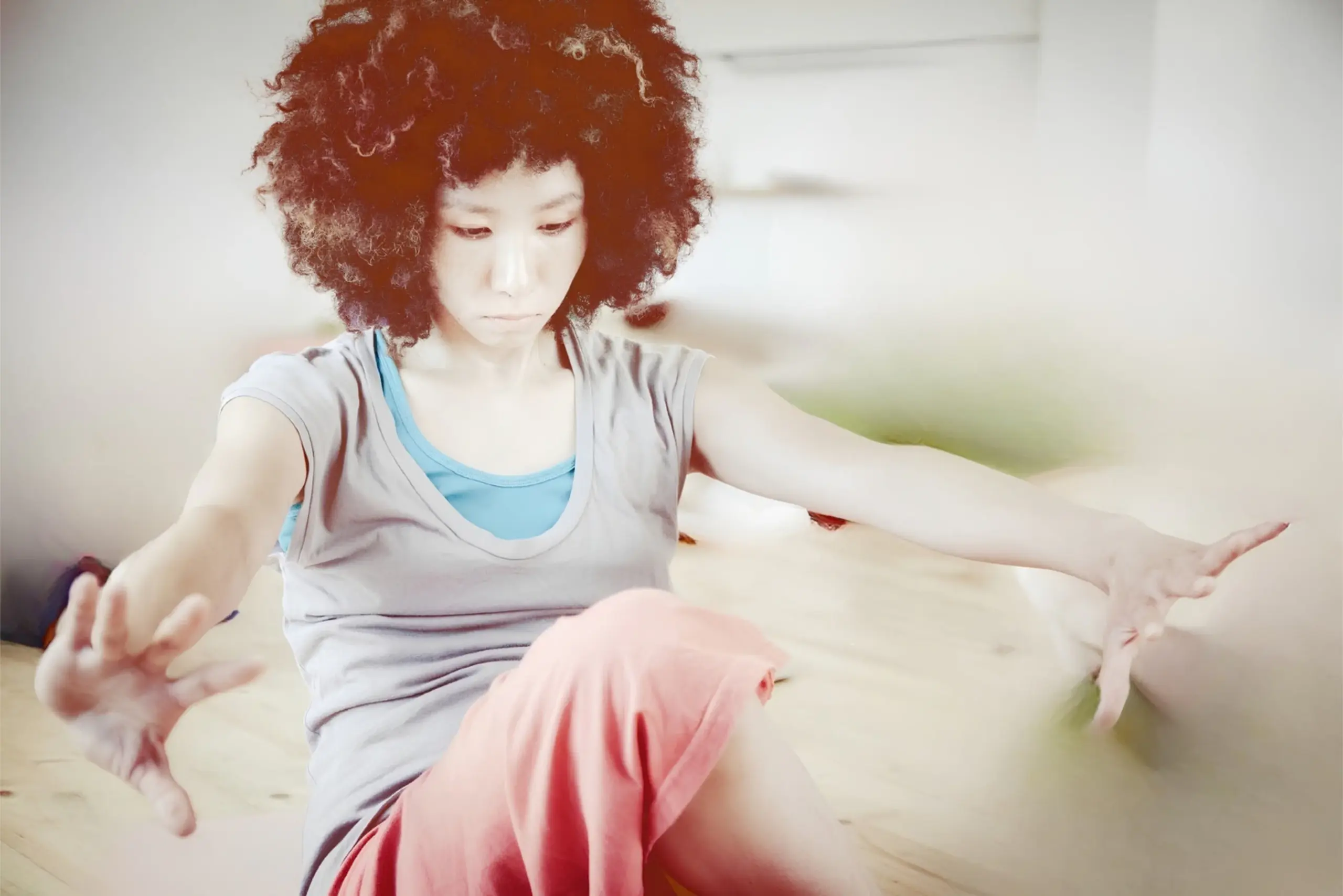
In my sensorium, simply sitting upright has a texture: a low hum in the muscles that are holding me here, louder in some places and quieter in others, and I can move my attention across it the way one moves their gaze across an artwork. Walking, the trajectory of each joint and other points on the body is something I can follow, like separate threads in a piece of music, and following it is pleasant in itself. I don’t need to do parkour to sense it, in the same way that nobody needs a Picasso to exercise their vision. A sandwich will do too.
I didn’t pay attention to any of this until I was almost thirty. In part because nobody ever tried to make any of it a shared referent. In part, because even when I paid attention, what I could sense was underdeveloped. To be fair, some people shared procedures. For example, my first dance teacher recommended barefoot walking. But she never tried to explain what I’d feel—just that this is the kind of thing she does to improve her dance skills. So, it was like being handed a closed box without being told what was inside.
I eventually developed proprioceptive awareness through procedure, which is to say, through practice. Now the perceptual referent is there, but with no shared language, I read the Guardian and feel like a character from a story H.G. Wells wrote in 1904.
In my personal vocabulary, 1904 is as iconic as 1984 is for most people. 1904 stands for being a stranger in a different sensorium. The only difference is that Nuñez arrived in the valley with nothing but his claims about a sense nobody else had. And a procedure is something that can be shared.
References
- The Guardian. “The power of proprioception: how to improve your sixth sense and become healthier and happier.” July 2024.
- Shcherbakova, Ksenia Asia. “The Mystery of Proprioceptive Awareness.” Baseworks, 2022 (updated 2026).
- Shcherbakova, Ksenia Asia. “The Triple Irony of Asking How Dancers Feel.” Baseworks, 2026.
- Wells, H.G. “The Country of the Blind.” 1904.
- Jay, Martin. Downcast Eyes: The Denigration of Vision in Twentieth-Century French Thought. University of California Press, 1993.
- McAdams, Stephen. Perception and Cognition of Music: The Sorbonne Lectures. Oxford University Press, 2024.
- Oancia, Patrick. “Sensitivity as a Trainable Skill.” Baseworks, 2026.
- Oancia, Patrick. “What You Can’t Feel, You Can’t Change: Body Awareness and the Perception Gap.” Baseworks, 2026.
- Oancia, Patrick. “What’s Between the Notes.” Baseworks, 2026.
- Winawer, J., Witthoft, N., Frank, M.C., Wu, L., Wade, A.R. and Boroditsky, L., 2007. “Russian blues reveal effects of language on color discrimination.” Proceedings of the National Academy of Sciences, 104(19), pp.7780-7785.
- Needle-threading video (tactile method): https://www.youtube.com/watch?v=0th9P6LP8XA


 Apple Podcasts
 Spotify
 Overcast
 Castro
 Amazon Music
 CastBox
 YouTube
 RSS
RSS Goodpods
 iHeartRadio