
Exploring movement learning through AI revealed something unexpected: the parallels run both ways, illuminating how both embodied intelligence and machine learning emerge from the same patterns.
Why I’m Fascinated by AI as a Thinking Partner
I’m still learning about AI, but I’ve discovered how valuable it is for gaining new insights. It’s not a shortcut—it helps me understand patterns that emerged from years of practice.
Like any learning process, whether linear or non-linear, there are reference points that deepen understanding. For me, it’s how Baseworks evolved through practical work with thousands of learners and dozens of instructors at our Tokyo studio. Different feedback loops emerged from these interactions—between instructors and learners, and between me and the instructors.
We had a rule at our Tokyo studio: every instructor had to attend each other’s classes. Even I, as the founder, attended everybody’s classes and was often humbled by the insights that came from each instructor’s unique perspective on how they wanted to deliver the practice. Although we had technical benchmarks for every aspect of the method, instructors’ interpretations still differed based on how they observed their learners.

What became crucial was my imposing consistency at a level rarely seen in regular movement classes for people of any background. You typically only see this kind of consistency required in elite athletics, dance or other high-level physical performance, not for the general population who often have low body awareness. What happened from enforcing this consistency in movement execution and understanding was that it started to reveal, very unexpectedly, various bottlenecks in perception and physical capacity. The method itself in its entirety had to adapt to accommodate everyone, including those people with less capacity. That really shaped the method—that was one of the most important forces driving its evolution.
Many of these insights came as “aha moments” rather than through formal research. They emerged naturally from a continuous cycle of teaching, observing, and refining.
From an outside perspective, you could say the practice started as something focused on health, but my desire was never to make it health-specific. I wanted to explore something more abstract: if you commit to learning a language—the syntax, grammar, vocabulary—the better you can express yourself across different domains of information sharing. Similarly, the more you use your body across different domains of physical learning, the more you can express yourself in physical activity.
As a byproduct, I found connections with everything else in my life—how I perceived interactions with colleagues, how I reacted to weather not matching my expectations. These experiences fed into a greater awareness of life’s patterns, immediately surfacing lessons about expectation and the downfalls of over-expecting. This experience fundamentally shaped my understanding of how deep practice affects not just physical capacity but perception itself.
Working with AI feels like an extension of that same feedback loop, just faster and broader. AI has become a thinking partner that excels at understanding my cross-domain correlations. When I’d explain these connections to people, they’d often find them too abstract because it doesn’t map onto their knowledge and experience. AI gets these connections immediately and helps me clarify them so I can share them more effectively.
When Bodies Think Like Neural Networks
Baseworks developed over 10+ years with thousands of learners and dozens of instructors, all focused on one goal: making movement instruction clearer. We wanted anyone, regardless of their background, to understand and perform the same movements in the same way. This wasn’t designed top-down by theory; it emerged bottom-up from real classroom experience. The six principles that crystallized from this process represent the shared patterns of how movement is best understood and performed across thousands of bodies. Similarly, artificial intelligence systems improve through massive datasets, identifying patterns that emerge from collective input rather than predetermined rules.
When you move using Baseworks principles, something interesting happens. Your attention spreads across multiple points at once. You’re sensing contact, controlling how muscles engage, and adjusting to changes—all while following cues that direct your awareness. This multi-point attention is the core of Baseworks’ Sense-Control-Adapt approach: sensing multiple body points, controlling engagement patterns, and adapting to conditions. AI systems work similarly—maintaining context, applying rules, and adjusting responses across different information streams.
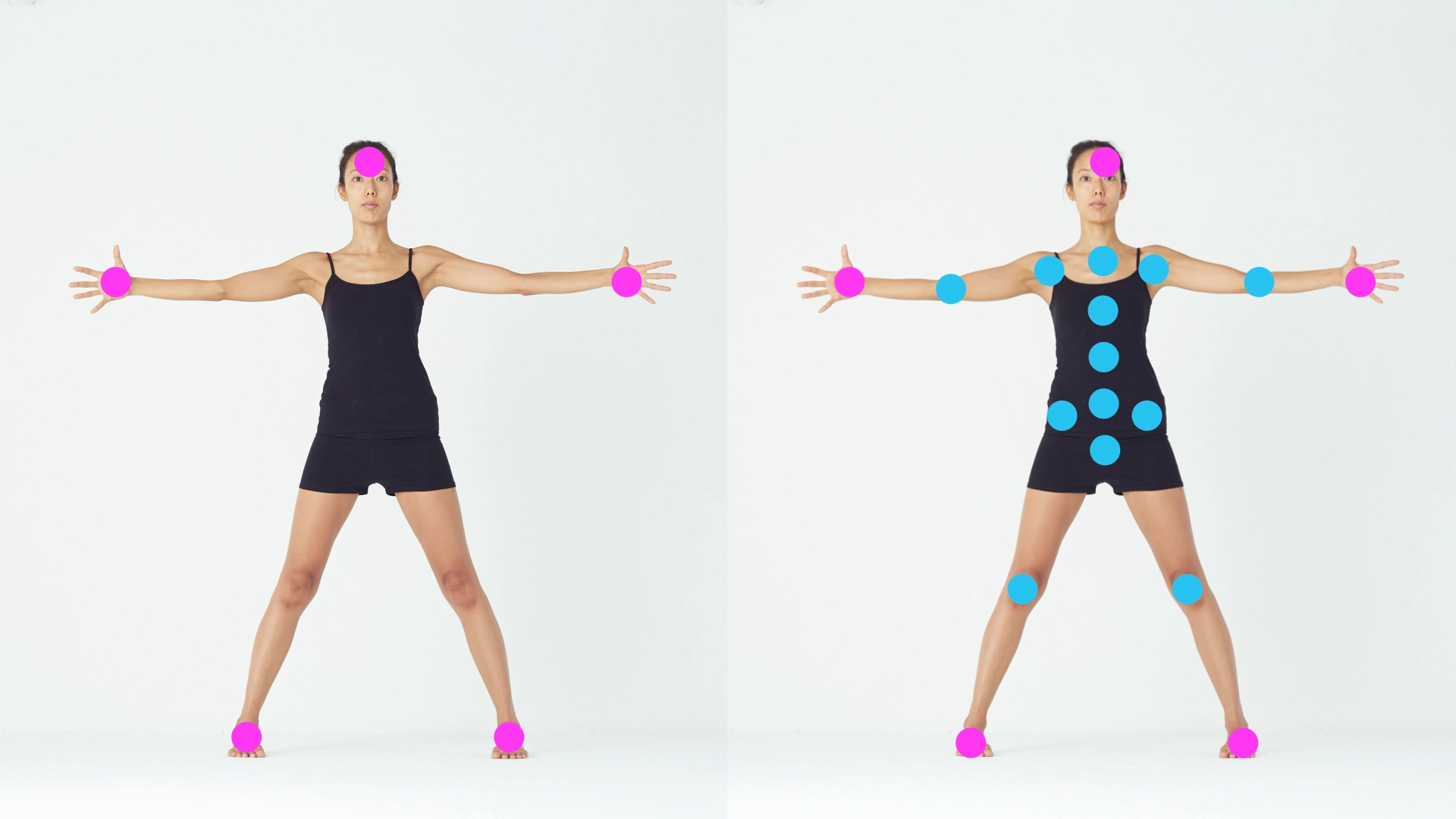
Modern AI systems don’t store information in one place—they build networks of connections between different types of data. Brain science shows something similar: isolating one finger requires more brain activity than moving all fingers together, because your brain has to actively prevent other fingers from moving. When you turn on distributed activation in Baseworks—performing multiple precise movements at once across your whole body—your motor cortex lights up. Different brain areas overlap as each movement prevents automatic patterns from taking over.
One of the most interesting parallels is how attention works. Baseworks uses a teaching approach called WHILE-NOT-IF-DO that breaks down each movement into four parts: (1) what to maintain before starting, (2) what to avoid doing, (3) what to check for, and (4) what to do next based on those checks. This approach to attention mirrors how AI systems process conditional logic across multiple data streams simultaneously—maintaining context, applying constraints, evaluating conditions, and selecting appropriate responses. Both are training pattern recognition that operates across domains, building transferable intelligence rather than isolated skills.
Both systems are doing the same thing: taking knowledge that’s difficult to express and turning it into something that can be taught, improved, and shared. AI memory systems reveal hidden correlations between seemingly unrelated data points. Baseworks creates a somatic vocabulary that makes unconscious sensory processing conscious and communicable—taking movements that can be performed without momentum and applying principles that train perceptual skills most people didn’t know existed.
What This Means for You
Baseworks captures physical intelligence that emerged from applying unique consistency standards with diverse groups of people. This process revealed how people actually perceive and move, which shaped the entire method. Just as AI distills collective human knowledge into an accessible format, Baseworks distills collective embodied intelligence into learnable principles.
The parallels between these systems offer more than theoretical interest. They suggest that intelligence—whether in neural networks or human bodies—emerges through similar patterns: processing information across multiple points, refining through repeated interaction, managing attention systematically, and turning implicit knowledge into communicable form.
For anyone interested in how we learn, move, or develop new capacities, Baseworks offers a practical laboratory for exploring these principles. The patterns that emerged from optimizing movement communicability apply beyond physical training—to how we process information, make decisions, and adapt to complex environments.
A Note on How This Article Came to Be
I spent 3 days working with Claude AI (Sonnet 4.5, using OpenMemory MCP specifically) to write this. We pulled together two decades of materials and ideas, exploring different ways to explain these connections. The collaboration itself demonstrates the point—AI helping to surface patterns from long-term practice & research and make them easier to share.


 Apple Podcasts
 Spotify
 Overcast
 Castro
 Amazon Music
 Anchor
 CastBox
 Radio Public
 Breaker
 YouTube
 RSS
RSS Goodpods
 iHeartRadio